
Prop Firm Marketing in 2026: How to Lower Your Cost per Challenge Sold

A 2026 guide to prop firm marketing: why paid reach got riskier, the funnel from tap to challenge sold, ads that pass review, and a community that brings traders back.
On this page
- What is prop firm marketing?
- Why prop firm marketing got harder in 2026
- The prop firm marketing funnel: from tap to challenge sold
- Where prop firm marketing budgets go
- How to run prop firm marketing on Meta without losing the account
- Cost per challenge sold, and the numbers after it
- Build the community you own
- How the Fellows Hub fits prop firm marketing
- The firms that own their audience win
- Frequently Asked Questions
Key takeaway: Prop firm marketing in 2026 is a fight for reach you can rely on. Paid ads still work, but pages and ad accounts can disappear without warning, so judge every channel on cost per challenge sold, keep the creative far from income promises, build a community you own, and track each trader from the first tap to the purchase.
Prop firms sell something unusual: a paid evaluation, often called a challenge, that a trader has to pass before trading the firm's capital. That changes the marketing. The firm is paid at checkout, not at deposit, many buyers fail and buy again, and the platforms that sell the ads are nervous about anything that sounds like easy money.
I run Meta campaigns and Telegram funnels for trading brands. This guide is the prop firm marketing setup I would use today, written for prop firm founders, growth leads and the media buyers and affiliates who work with them.
What is prop firm marketing?#
Prop firm marketing is how a proprietary trading firm finds traders who buy its evaluations, and keeps them coming back. Unlike a broker, a prop firm is paid when the trader buys the challenge, so the first number that matters is cost per challenge sold. The second is how many of those traders buy again.
Everything else, from clicks to followers, is only useful if it moves one of those two numbers.
Why prop firm marketing got harder in 2026#
Three things changed the picture this year.
- Accounts went missing. In April and May 2026, several prop firms lost Instagram or Facebook accounts or saw their ads stop, as TradeInformer reported. There was no clear pattern, and some of the largest firms were not affected.
- Ads get closer review. Meta and Google both treat leveraged trading and funded-trader offers as high-scrutiny financial advertising, so disapprovals and country limits are common. Track360's overview explains why that pushes firms toward partners.
- Partners carry more of the load. Affiliates, creators and trading communities are paid on results and reach traders in places paid ads cannot.
The prop firm marketing funnel: from tap to challenge sold#

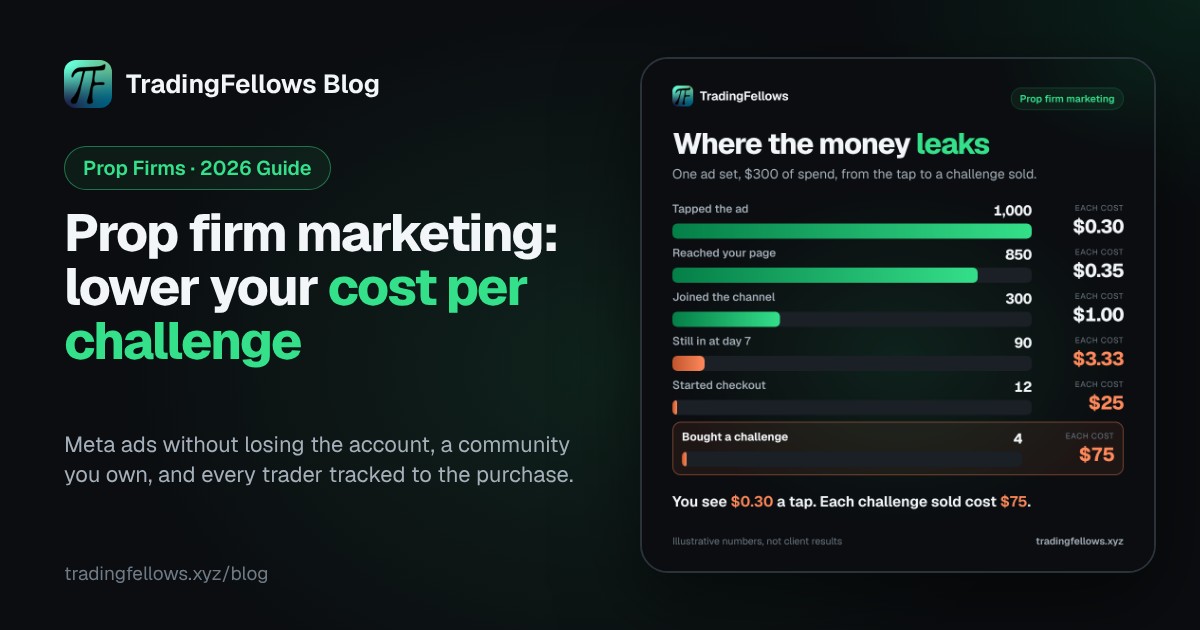
A typical paid funnel has six steps: the tap, the landing page, the community (a Telegram channel or a Discord server), the traders who stay, checkout, and the purchase. Each step loses people, and each one changes what a sale really cost.
- Tapped the ad1,000
- Reached the page85085% of the step before
- Joined the community30035% of the step before
- Still in at day 79030% of the step before
- Started checkout1213% of the step before
- Bought a challenge433% of the step before
Illustrative numbers. Tap "Use my numbers" to put in yours.
The big drop is usually between the community and checkout. Traders join to watch and learn, and buying is a second decision. Clear rules, honest payout news and a personal link at the right moment are what move it.
Where prop firm marketing budgets go#
| Channel | How you pay | Main risk | Best for |
|---|---|---|---|
| Meta ads | Ad budget | Page and ad account removals | Testing angles, reach |
| Google search | Ad budget | Certification and country limits | Traders already comparing firms |
| Affiliates and creators | Per sale | Less control of the message | Trust at scale |
| Telegram or Discord community | Time and content | Low, you own it | Retries and repeat buyers |
| Time | Low | Discounts, resets, rule updates |
How to run prop firm marketing on Meta without losing the account#
- Sell the evaluation, not the money. Show the rules: the profit target, the drawdown limits, the platforms, how long a trader has. Traders who buy knowing the rules are less likely to feel misled later.
- Describe the product, never the reader's income. "A $100K evaluation with an 80% profit split" describes a product. "Make $8,000 a month trading our capital" is an income claim, and Meta's financial products and services policy is strict about those.
- No lifestyle, no screenshots of payouts as bait. Cars, watches and payout screenshots read as get-rich promises in review.
- Keep your business assets in good order. Use a verified business account with more than one admin, so one locked personal profile does not take the page down with it.
- Send every ad to your own page, then the community. The page carries your pixel and the ad set's link. A bare link to Telegram or Discord tells you nothing about which ad worked.
- Report the purchase back to Meta. Send the checkout and the purchase through the Conversions API with the sale value, so Meta learns who buys, not who clicks.
Cost per challenge sold, and the numbers after it#
Cost per challenge sold tells you what the first purchase cost. It does not tell you what the trader was worth. Two ad sets with the same cost per challenge can be worth very different amounts.
- Repeat purchases. A trader who fails and buys again, or buys a reset, is worth more than one who leaves after the first try.
- Refunds and chargebacks. An ad set that brings buyers who dispute the charge is more expensive than its cost per challenge says.
- Who stays in the community. Traders still in your channel a week after joining are the ones who buy again. It is the earliest signal you can read.
Build the community you own#
A community is the one channel no platform can switch off. For prop firm marketing it does three jobs: it keeps traders who joined from an ad, it brings back the ones who failed, and it gives partners somewhere to send people.
- One clear promise. Daily market notes, rule reminders, a weekly review. Say it in the description and the pinned post.
- A welcome for every trader. Let a bot greet each person who joins, explain the rules in plain words and hand them a link of their own to checkout.
- Real payout news, with consent. Announce payouts that happened, with the trader's permission, as news, not as a promise.
- One invite link per source. Every ad set, partner and creator gets its own link, so you can see who brought the traders who stay and buy.
Where does your funnel drop the most?
The ad and the page say different things. Lead with the rules and keep one button.
Go to the fixFix the welcome, the pinned guide and the posting rhythm before buying more traffic.
Go to the fixGive each trader a link of their own to checkout, and answer the rules questions in public.
Go to the fixGive every ad set and partner its own link first, then look again in two weeks.
Go to the fixHow the Fellows Hub fits prop firm marketing#
- Fellows AI writes the ads from one line and checks every line against Meta's finance rules before you see it. Income claims and "guaranteed" get flagged.
- Pages hosts the landing page with your pixel, checked every 5 minutes.
- Channels gives every ad set and partner its own link, counts joins and who is still in at day 7, and takes the sale from your checkout's postback.
- Your bot greets each trader and hands them a link of their own.
- Pass it on sends joins and sales back to Meta.

The firms that own their audience win#
Prop firm marketing in 2026 rewards the firms that do not depend on one platform. Sell the evaluation on its rules, keep the creative free of income promises, track every trader to the purchase, and build a community that brings them back.
If you want the tracking, the pages and the ads in one place, see the Fellows Hub at tradingfellows.xyz. Questions go to the operator on Telegram: t.me/TradingFellowsAds.
Frequently Asked Questions
What is prop firm marketing?
Can prop firms advertise on Facebook?
What is a good cost per challenge sold?
Should a prop firm use affiliates?
How do I bring back traders who failed a challenge?
Keep reading
Telegram Ads for Forex | How Brokers and Affiliates Actually Generate Leads in 2026
There are three ways to run telegram ads for forex: the official Telegram Ads platform, paid placements in exi
Telegram Invite Link Tracking: How to Track Every Ad Set in 2026, Step by Step
How to give every ad set its own Telegram invite link, what Telegram counts for free, and how to track who is
Forex Signals Telegram Channel: How to Run Ads That Pass Review (2026)
What each platform allows for a forex signals Telegram channel, how to write ads that pass review, and how to