
Cost Per Telegram Subscriber: The Complete 2026 Guide to a Number Most People Get Wrong

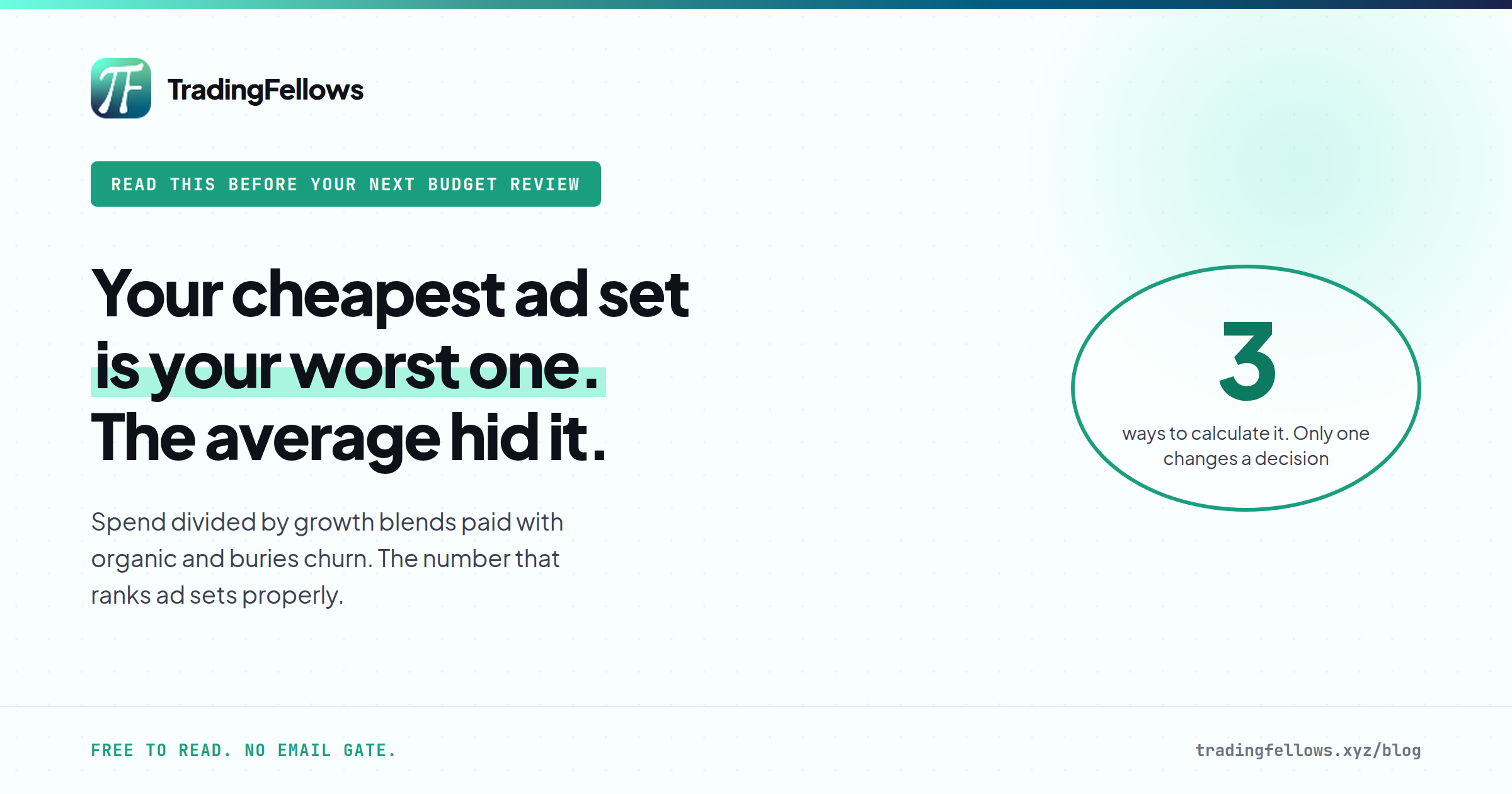
Spend divided by member growth blends paid with organic and nets out churn. The version worth deciding on is what one ad set paid per member still there a week later.
On this page
Somebody asks what it costs you to get a subscriber.
You open Ads Manager, take the month's spend, open Telegram, take the member growth, and divide. Four thousand dollars, 1,650 new members, two dollars forty. You say it out loud with confidence and everybody nods.
That number is fiction, and you are about to set next month's budget with it.
Not because you did the division wrong. Because both inputs are measuring something other than what you think. The top number includes spend that produced nothing. The bottom number includes people who arrived on their own, and excludes the ones who joined and left before you counted.
I want to walk you through what a cost per telegram subscriber figure is actually made of, the three reasons the simple version misleads, and the one variant of it that is worth making a decision on.
The short answer: Cost per telegram subscriber is normally calculated as ad spend divided by member growth, and that is wrong in three ways at once.
Member growth nets out people who left, so churn silently inflates your cost.
It includes organic and word-of-mouth joins you did not pay for, which deflates it.
And it is a channel-wide average, so it cannot tell you which ad set to scale.
The number worth having is cost per member who is still there after seven days, calculated per ad set from attributed joins.
What cost per telegram subscriber actually measures#
A cost per telegram subscriber figure is only as honest as the two numbers you divide. In the usual version, both are wrong.
The spend is real but unallocated. You know what the account spent. You do not know which part of it produced members, because Meta reports clicks and your channel reports members, and nothing connects the two.
The member number is a net figure. Telegram shows you where the count ended up, not what happened. A month with 400 joins and 250 leaves looks identical to a month with 150 joins and no churn. Those are wildly different months and one of them is a problem.
So the standard calculation answers a question nobody asked: what did we spend per unit of net growth, from all sources combined, over a period long enough to hide everything interesting?
Three reasons the simple cost per telegram subscriber misleads#
Organic joins are in your denominator. Forwards, screenshots, someone pasting your @username into a group chat, people who found you months ago and finally joined. Every one of those makes your paid acquisition look cheaper than it is. The better your organic reach, the more flattering · and more useless · the number becomes.
Churn is netted out invisibly. If 400 people join and 250 leave, your growth is 150 and your apparent cost per subscriber triples. But you did not fail to acquire 400 people. You acquired them and lost most of them, which is a completely different problem with a completely different fix. One is a targeting problem. The other is an offer or expectation problem.
It is a single number for the whole channel. Even if the first two were clean, a channel-wide average cannot tell you which ad set to scale. The average is where good and bad ad sets go to cancel each other out.
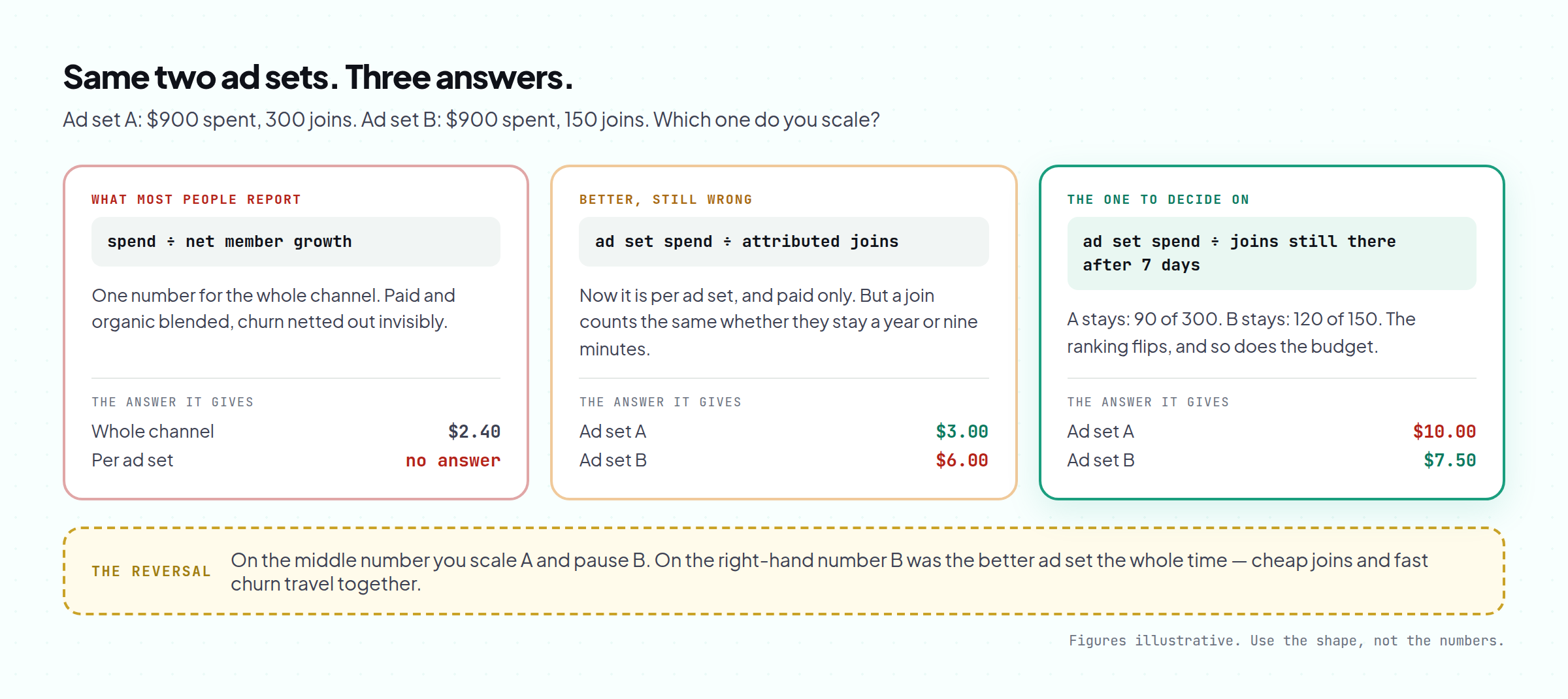
Here is the same month, calculated three ways:
| How you calculate it | What it answers | When it misleads |
|---|---|---|
| Spend ÷ net member growth | Roughly what a month of growth cost, from all sources | Constantly. Organic deflates it, churn inflates it, and it cannot guide a budget decision |
| Spend ÷ attributed joins, per ad set | What each ad set paid per join it actually produced | When joins churn fast · a cheap ad set can be the worst one |
| Spend ÷ attributed joins still present after 7 days | What each ad set paid per member who stayed | Rarely. This is the one to run budget on |
The cost per telegram subscriber worth deciding on#
Run this on your own figures rather than trusting anybody's benchmark.
cost per member who stays = ad set spend ÷ (attributed joins from that ad set that are still in the channel after 7 days)
Take two ad sets that look like this on a joins-only report:
- Ad set A: $900 spent, 300 attributed joins. $3.00 per join.
- Ad set B: $900 spent, 150 attributed joins. $6.00 per join.
- Ad set A: 90 of the 300 are still there. $10.00 per member who stayed.
- Ad set B: 120 of the 150 are still there. $7.50 per member who stayed.
Those figures are illustrative, not benchmarks. Use the shape, not the numbers.
There is very little reliable public data on cost per telegram subscriber from Meta traffic, and most of what circulates is either about Telegram's own ad platform, which is a different buying mechanism entirely, or a single case study from one offer in one country.
Geo, vertical, offer strength and the quality of the landing step move this number by multiples.
A benchmark from someone else's funnel tells you almost nothing about whether yours is healthy.
Your own trend, per ad set, week over week, tells you everything.
How to produce a cost per telegram subscriber you can trust#
A trustworthy cost per telegram subscriber needs three things to be true, and most operators have none of them:
- Joins matched to ad sets. You need to know which ad set produced each join, which means routing clicks through a page you control and issuing a join link unique to each visitor. The mechanism is in Telegram conversion tracking.
- Churn counted from a fixed point. A bot can only report on members from the moment it was added to the channel. Departures from before that are invisible, and counting them as churn from your current ads mixes two unrelated groups.
- A seven-day window you apply consistently. Any window works as long as it never changes. Switching from three days to fourteen halfway through a quarter makes your own trend meaningless.
This is what the Plan produces: joins per ad set, how fast joiners leave, and who is still there a week later, alongside the landing page those clicks hit. $99 a month from your balance covers the page and one tracked channel, with additional channels at $19 a month.
If your joins-only numbers already look wrong, the upstream version of the problem · clicks that never became visits at all · is in high CTR, no conversions.
What a better number will not do#
- It will not reduce churn. Knowing precisely which ad set brings people who leave is the diagnosis. Why they leave is your offer, your pinned post and what the ad promised.
- It will not attribute everything. Joins through your public @username stay anonymous. Judge ad sets on attributed joins and treat the rest as an organic layer you do not control.
- It will not make small numbers meaningful. An ad set with 11 joins does not have a reliable retention rate. Wait for volume before killing anything on it.
- It will not survive a dead ad account. Measurement does not protect the account being measured, which is a separate problem.
The bottom line#
Cost per telegram subscriber is the number everyone quotes and almost nobody calculates in a way that could change a decision. Spend divided by member growth blends paid with organic, hides churn inside a net figure, and averages your best ad set together with your worst.
The version worth having is narrower and far more useful: what one ad set paid for each member who was still there a week later. It usually reorders your ad sets, and it frequently promotes the one you were about to pause for being expensive.
So before your next budget review, do this. Take last month's spend and your net member growth and write down the naive number. Then write down, honestly, how many of those members arrived from sources you did not pay for, and how many of the ones you did pay for are still in the channel. If you cannot answer either question, that is the real finding · and it means the number you have been reporting has been a guess wearing a decimal point.
PS. The quickest way to feel this problem is to check a single ad set's joins from three weeks ago and count how many are still members today. Most people have never looked. The first time you do, it changes which ad set you think is your best one.
Frequently Asked Questions
How do you calculate cost per Telegram subscriber?
What is a good cost per Telegram subscriber?
Why does my cost per subscriber look cheap but the channel is not growing?
Should I include organic joins in the calculation?
How long should I wait before judging retention?
Why does my cheapest cost per telegram subscriber come from my worst ad set?
Keep reading
Telegram Ads for Forex | How Brokers and Affiliates Actually Generate Leads in 2026
There are three ways to run telegram ads for forex: the official Telegram Ads platform, paid placements in exi
Telegram Invite Link Tracking: How to Track Every Ad Set in 2026, Step by Step
How to give every ad set its own Telegram invite link, what Telegram counts for free, and how to track who is
Forex Signals Telegram Channel: How to Run Ads That Pass Review (2026)
What each platform allows for a forex signals Telegram channel, how to write ads that pass review, and how to