
Telegram Channel Retention Rate: The Complete 2026 Guide to Measuring It

Six hundred joined, five hundred and ten left, the counter moved ninety. Retention is a cohort measure, and measured properly it judges an ad set in two days.
On this page
- What telegram channel retention rate actually measures
- Why your telegram channel retention rate is readable on day two
- Four reasons your telegram channel retention rate collapses in 48 hours
- How to measure a telegram channel retention rate properly
- What a healthy telegram channel retention rate looks like
- What better measurement will not do
- The bottom line
- Frequently Asked Questions
The channel sits at 4,200 members this morning. Last month it was 4,110.
You spent real money getting there. Six hundred people joined. The counter moved by ninety.
Five hundred and ten people arrived, looked around, and left · and you have no idea which ad set sent them, how long they lasted, or what they saw in the first minute that made them go. The member counter does not report departures. It reports the arithmetic after the fact, quietly, so the only thing you feel is that growth is slower than your spend suggests it should be.
Scaling that campaign does not fix it. It widens the hole.
I want to walk you through what a telegram channel retention rate actually is, why the first 48 hours tell you more than the first week, the four things that make people leave that fast, and how to measure it in a way that survives contact with your own data.
The short answer: Telegram channel retention rate is the share of a specific group of joiners still present after a fixed window · not a single number for the whole channel.
It has to be measured as a cohort: people who joined on the same day, from the same ad set, checked again at the same point.
Early churn is the useful signal, because most departures happen in the first 48 hours and that is long before your member counter settles.
Measure leaves separately from joins, count only from the moment your bot was added, and never change the window once you pick it.
What telegram channel retention rate actually measures#
A telegram channel retention rate is not one figure. The moment you try to express it as a single percentage for the whole channel, you have destroyed the thing that made it useful.
It is a cohort measure. A cohort is a group who joined in the same window · one day, one week · and ideally from the same ad set. You then check that same group again at a fixed point afterwards. The number you get is the share of those people still present.
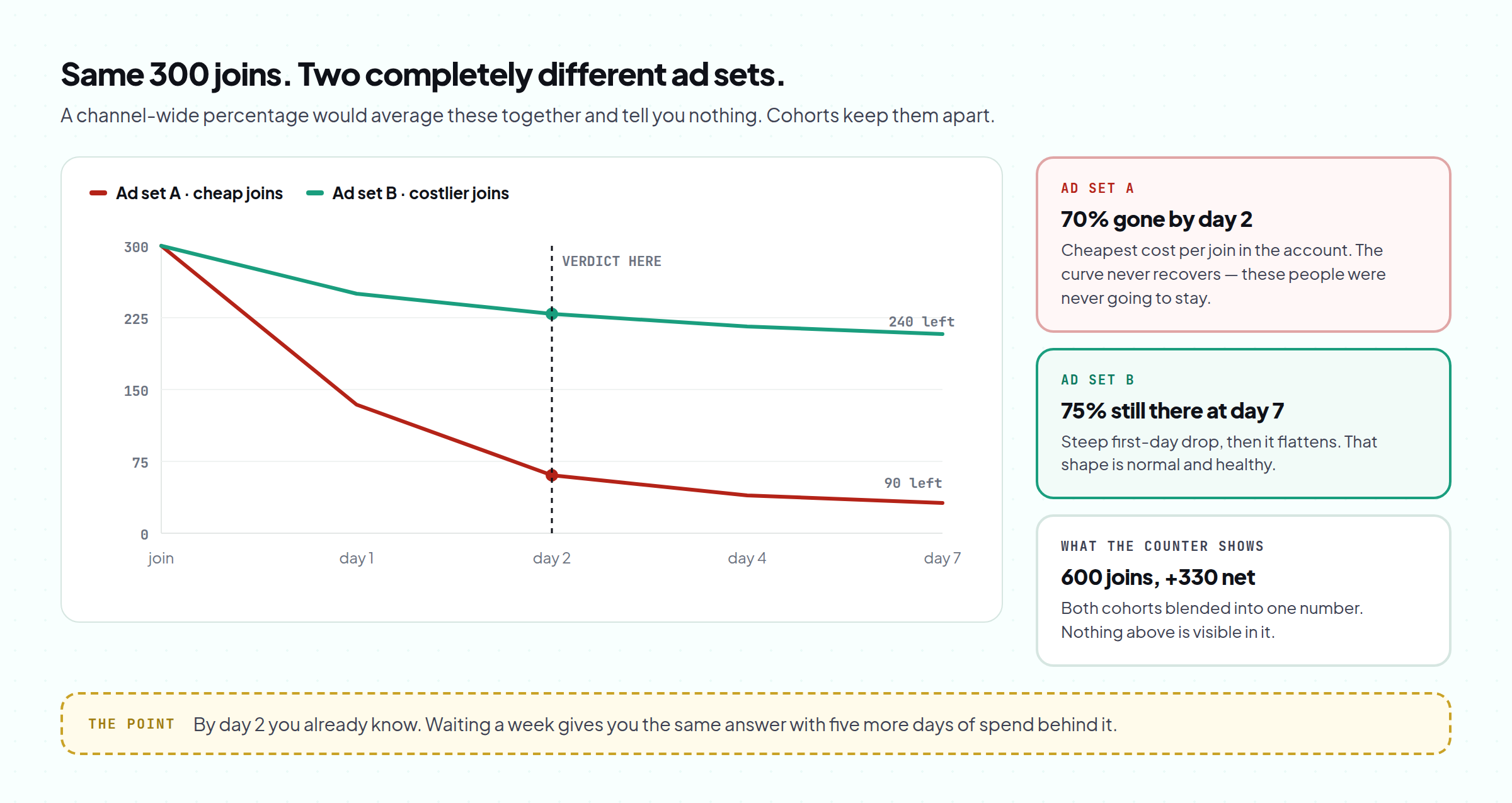
Why this matters: a channel-wide percentage blends a cohort from eighteen months ago with one that arrived on Tuesday. The old members are self-selected survivors who barely churn. They drag the average up and hide the fact that everyone arriving this week is leaving by Thursday.
Three numbers, all real, all describing the same month:
- Net growth: +90. Tells you nothing about what happened.
- Channel-wide retention: high, because most of your members are long-timers. Flattering and useless.
- Cohort retention for last Tuesday's joiners from ad set B: the number that changes a decision.
Why your telegram channel retention rate is readable on day two#
Most churn in this niche is fast, which is what makes a telegram channel retention rate useful so early. People join, the channel does not look like what the ad implied, and they leave the same evening or the next morning. After the first couple of days the curve flattens hard · the people still there at day three are mostly still there at day thirty.
That has a practical consequence that is worth more than any dashboard: you can judge an ad set in about 48 hours.
Wait a week and you are not getting a better answer, you are getting the same answer later, with five more days of spend behind it. Wait for the member counter to settle and you are reading net growth, which is the number that hid the problem in the first place.
The trade-off is honest: a two-day read on a small cohort is noisy. The fix is volume, not patience. Forty joins from one ad set gives you a usable early signal. Eleven does not, and killing an ad set on eleven joins is how people convince themselves that measurement does not work.
Four reasons your telegram channel retention rate collapses in 48 hours#
A poor telegram channel retention rate is usually a content problem wearing a traffic problem's clothes. When a cohort collapses immediately, it is almost always one of these.
The ad promised something the channel is not. The single most common cause. The ad implies daily signals, the channel is a sales feed. The ad implies free access, the first pinned message asks for a deposit. These people are not badly targeted · they were correctly targeted and then disappointed, which is worse, because you paid full price for the disappointment.
The arrival experience is empty. Someone joins, sees a pinned post written eight months ago and the last message from Sunday, and leaves. The channel is fine. The first thirty seconds of it are not.
The posting rhythm is a shock. Forty messages a day to someone who joined for a weekly summary reads as noise. Notifications are the fastest uninstall button ever built.
The audience was wrong in a way clicks cannot show. Cheap clicks and fast churn travel together, because the targeting that produces effortless joins produces people with no particular reason to stay. That is the one where the traffic really is the problem · and it is last on this list, not first.
| What you see | Most likely cause | What to change |
|---|---|---|
| One ad set collapses, the others are fine | Ad promise does not match the channel | The creative, not the channel |
| Every cohort collapses at the same rate | Arrival experience or cadence | Pinned post, first-hour message, posting rhythm |
| Churn spikes the day after a big posting day | Notification fatigue | Frequency and muting guidance |
| Joins are cheap and churn is brutal across the board | Audience quality | Targeting, and the traffic quality upstream |
First: counting departures from before your bot joined the channel.
A Telegram bot can only report on membership changes it observed, which starts the moment it was added · see the Bot API.
Older members leaving are invisible to it, and any tool that counts them as churn from your current ads is blending two unrelated populations and making good ad sets look terrible.
Second: comparing cohorts of wildly different sizes, or changing your measurement window mid-quarter. A cohort of 11 has no reliable retention rate.
Moving from a three-day window to a fourteen-day one halfway through makes your own trend meaningless · and your own trend is the only benchmark that means anything here.
How to measure a telegram channel retention rate properly#
Four rules. All of them are about consistency rather than sophistication.
- Count joins and leaves separately. Never work from the member counter. Net growth is the number that hides everything you are trying to see.
- Group by join date and by ad set. Both. Join date alone tells you the channel is leaky; adding the ad set tells you which spend caused it.
- Pick one window and keep it. Two days for the fast read, seven for the decision. Whatever you choose, never change it.
- Start the clock when your bot joined. Everything before that is unknowable, and pretending otherwise corrupts the comparison.
This is what the Plan reports per ad set · how fast joiners leave and who is still there after seven days, next to the landing page those clicks hit. $99 a month from your balance covers the page and one tracked channel; extra channels are $19 a month. The cost side of the same data, and why your cheapest ad set is often your worst, is in cost per telegram subscriber, and the attribution mechanism that makes any of it possible is in Telegram conversion tracking.
What a healthy telegram channel retention rate looks like#
Not a number, a shape · and I am not going to invent a benchmark, because there is no reliable public data on retention for Meta-sourced Telegram cohorts, and what circulates comes from different verticals, geos and offers. Anyone quoting you a percentage is quoting their funnel, not yours.
What you are looking for is the shape:
- A steep drop in the first 24 to 48 hours, then a curve that flattens. That is normal and not a crisis.
- A curve that keeps falling steadily through week two. That is unusual and points at cadence or content rather than acquisition.
- Cohorts that differ sharply from each other while the channel is unchanged. That is your ad sets talking, and it is the most actionable pattern on this list.
What better measurement will not do#
- It will not stop people leaving. A telegram channel retention rate is a diagnosis, not a treatment. It tells you which ad set and roughly when. Why they left is your pinned post, your cadence and what the ad implied.
- It will not attribute everything. Joins through your public @username cannot be traced to an ad set, so they sit in an organic layer you measure separately.
- It will not rescue a tiny cohort. Small numbers produce confident nonsense. Wait for volume.
- It will not fix an offer mismatch you refuse to look at. If every cohort from every source churns identically, the traffic is not the variable.
The bottom line#
The member counter is the worst metric on your channel, because it reports the difference between two numbers you actually needed to see separately. Six hundred joins and five hundred and ten departures looks exactly like ninety quiet arrivals, and only one of those is a business problem you can act on this week.
Telegram channel retention rate fixes that, but only if you measure it as a cohort · same join window, same ad set, same checkpoint, counted from when your bot could actually see. Do it that way and you get a verdict on an ad set in two days instead of eight, with the reason attached.
So this week, do the smallest version of it. Pick one ad set that sent you joins around three weeks ago. Count how many of those specific people are still in the channel today. Then do the same for a different ad set. If the two numbers are far apart, your acquisition is not one problem with one fix · it is two, and you have been funding the wrong one.
PS. If both numbers come back low, stop looking at ad sets entirely and open your own channel as a new member would see it: the pinned post, the last five messages, the notification volume on day one. The fastest retention fix is almost never in Ads Manager.
Frequently Asked Questions
How do you calculate a Telegram channel retention rate?
What is a good telegram channel retention rate?
How soon can I tell if an ad set brings people who stay?
Why do so many people leave my Telegram channel right after joining?
Will members who left before tracking count against my telegram channel retention rate?
Should I measure retention at 2 days or 7 days?
Keep reading
Telegram Ads for Forex | How Brokers and Affiliates Actually Generate Leads in 2026
There are three ways to run telegram ads for forex: the official Telegram Ads platform, paid placements in exi
Telegram Invite Link Tracking: How to Track Every Ad Set in 2026, Step by Step
How to give every ad set its own Telegram invite link, what Telegram counts for free, and how to track who is
Forex Signals Telegram Channel: How to Run Ads That Pass Review (2026)
What each platform allows for a forex signals Telegram channel, how to write ads that pass review, and how to