
High CTR No Conversions on Facebook Ads? The Complete 2026 Diagnosis

Your best-CTR ad set produced nothing, so you rewrote the page. If most billed clicks never became visits, none of those tests could have worked. Here is the order.
On this page
- What high CTR no conversions actually tells you
- Step one: the check that explains most high CTR no conversions cases
- Step two: break high CTR no conversions down per ad set
- Step three: now, and only now, look at the offer
- The measurement gap underneath all of this
- What this high CTR no conversions diagnosis will not fix
- The bottom line
- Frequently Asked Questions
Ad set two has a 4.1% click-through rate. Best in the account. You have been telling yourself for a week that the creative is finally working.
It has produced nothing. No joins, no leads, no sales.
So you do what everybody does. You rewrite the headline. You change the button color. You shorten the form. You swap the hero image for one with a face in it. Another four days, another few hundred dollars, same result.
Here is what makes this so expensive: you are fixing step three of a funnel that is broken at step one, and every test you run on the landing page comes back inconclusive because the problem never lived there.
Before you touch that page again, there is a two-minute check that tells you whether the people Meta charged you for ever arrived at all.
High CTR no conversions is rarely a copywriting problem, whatever the results pages tell you. I want to walk you through the diagnosis in the order that actually saves money: do the clicks arrive, do the arrivals behave like people, and only then, does the page convince them.
The short answer: High CTR no conversions is a symptom with three possible homes, and almost everyone starts at the wrong one.
First compare the link clicks Meta billed you for against the visits your page actually recorded · a large gap means the traffic is the problem, not the copy.
Second, look at behavior per ad set rather than in aggregate, because one bad ad set hides inside a healthy average.
Only third, when clicks arrive and behave like people, is the offer or the page at fault.
Fixing the page first is why the tests never conclude.
What high CTR no conversions actually tells you#
High CTR no conversions means one thing for certain: your creative is good at getting taps. That is all it means. A high click-through rate with nothing at the end is evidence about the ad, not about the offer, and not about the page.
A tap is not interest. It is the cheapest possible action on the internet, and Meta's delivery system will happily find you an audience that produces them by the thousand if clicks are what you asked for. The gap between "will tap" and "will act" is where this whole problem lives.
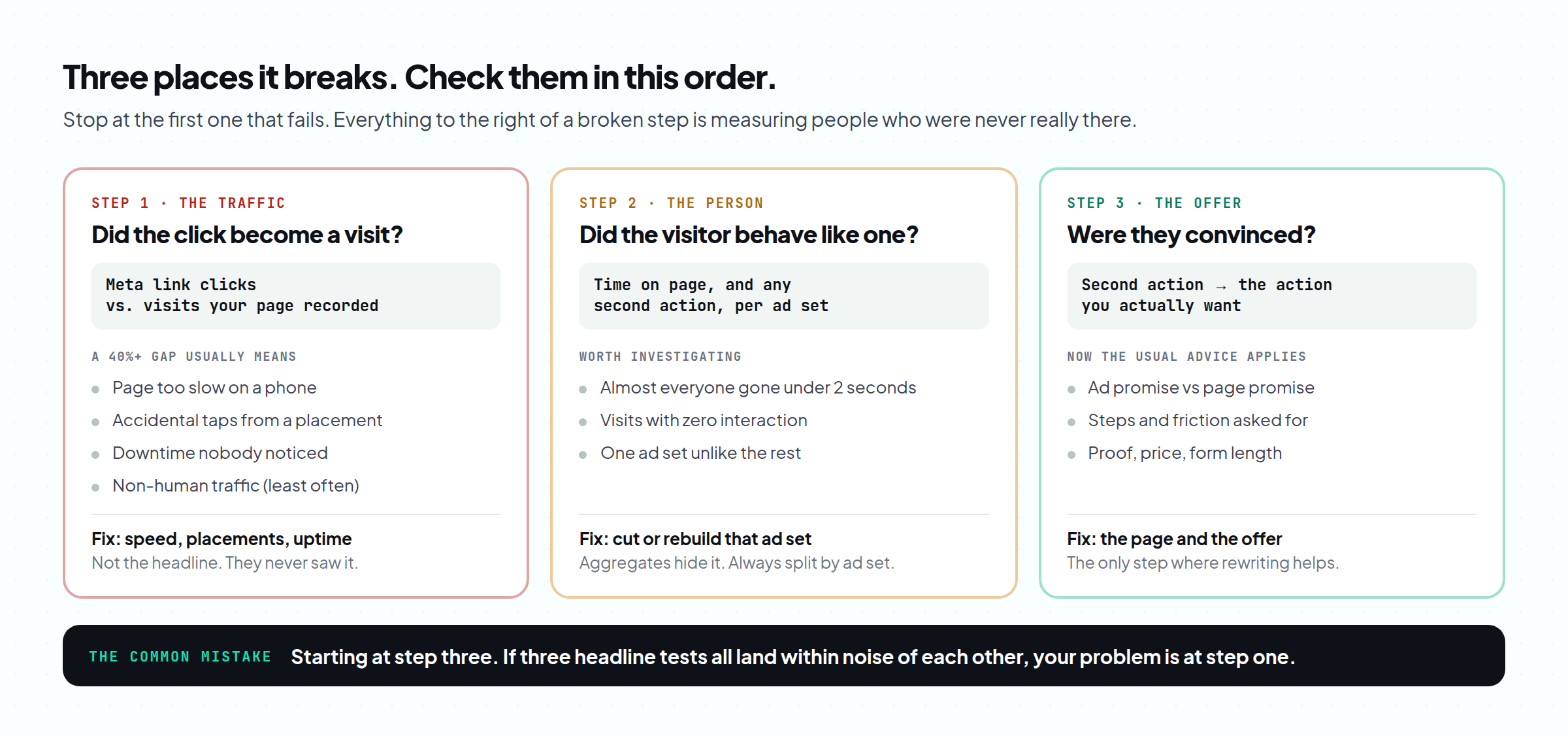
So high CTR no conversions splits into three very different failures, and they need three very different responses:
- The click never became a visit. Meta charged you, the person never landed. Nothing on your page can fix this.
- The visit was not a real prospect. They arrived, bounced in two seconds, or never behaved like a human at all.
- The visit was real and unconvinced. This is the only one where rewriting the page is the right move.
Step one: the check that explains most high CTR no conversions cases#
This is the check almost nobody runs, and it is the one that reframes everything.
Open Ads Manager and note the link clicks for one ad set over the last seven days. Then open your own analytics and note the visits that page recorded from that same ad set. Put the two numbers side by side.
They will never match exactly. A gap of ten or fifteen percent is normal · people tap and change their mind, connections drop, some visits go unrecorded. A gap of forty or sixty percent is not normal, and it tells you the problem is upstream of your copy.
The usual reasons for a large gap:
- The page is too slow on a phone. People leave before it finishes loading, so the click is billed and the visit never registers. Largest Contentful Paint on a real mobile connection is the number to look at, not how fast it feels on your laptop.
- Accidental taps. Placements in feeds and reels produce a lot of these. They count as clicks.
- The page was briefly down. If nobody is watching uptime, an outage looks exactly like a conversion-rate collapse.
- Non-human traffic. Real, and usually less common than people assume.
Step two: break high CTR no conversions down per ad set#
Aggregates hide the thing you are looking for, which is why high CTR no conversions so often looks like a campaign-wide mystery.
Take a campaign with four ad sets. Three are sending decent traffic, one is sending clicks that never arrive. In the campaign view you see mediocre performance and a plausible story about the offer being weak. The average conceals the culprit completely, and every conclusion you draw from it is about the wrong ad set.
The cut that matters is per ad set, across a few behaviors that arrive in order:
| What you compare | Healthy | Worth investigating |
|---|---|---|
| Clicks billed versus visits recorded | Within roughly 10–15% | A gap of 40% or more on one ad set |
| Time on page | Enough to read the first screen | Almost everyone leaving in under two seconds |
| Any second action, such as a CTA tap | A steady share of visitors | Visits with no interaction at all |
| The final action, such as a join or a lead | Follows the second action | Second actions that never become the final one |
It is the most satisfying explanation and often the wrong one.
Suspicious traffic is a signal, not a verdict: a real person on a work VPN can land in that bucket, and a careful bot on a phone network can avoid it entirely.
Treat a flag as a reason to look closer at one ad set, never as proof.
And be honest about the order · a slow page and accidental taps explain far more missing visits than fraud does, and both are things you can actually fix this week.
Step three: now, and only now, look at the offer#
If the clicks arrive, stay long enough to read, and take a first action, then your high CTR no conversions problem is genuine: a real audience that is not convinced. This is where all the standard advice finally applies: the promise in the ad matching what the page says, the number of steps you are asking for, the proof, the price, the friction in the form.
The reason this advice fails so often is not that it is wrong. It is that people apply it at step three while their problem sits at step one, then conclude that Facebook ads do not work for them.
One vertical-specific note. If your funnel ends in a Telegram channel rather than a form, you have an extra blind spot: Meta cannot see the join at all, so even a perfectly healthy funnel reports zero conversions. That is a measurement failure dressed as a performance failure, and it is covered in Telegram conversion tracking.
The measurement gap underneath all of this#
Diagnosing high CTR no conversions assumes you can see what happened after the click. Most operators cannot, for three reasons that compound:
Ads Manager stops at the click. It reports what it charged you for. What happened next is your responsibility to measure.
Browser events go missing. Ad blockers, privacy settings and people leaving early all remove events your pixel would otherwise send, so your own numbers understate reality by a margin you cannot see. Server-side events recover part of that, and where your pixel lives determines whether you keep any of it after a restriction · see where your pixel data actually lives.
Nothing is broken down by ad set. Most page analytics tell you about the page, not about which ad set sent each visitor, which is the only cut that lets you act.
This is exactly the gap the Plan is built to close: a landing page built, hosted and tracked, showing visits, CTA taps and joins per ad set, alongside real load times, uptime history, flagged suspicious traffic and blocked pixel events recovered. It is $99 a month from your balance, including one tracked Telegram channel, with extra channels at $19 a month.
You do not need to buy anything to run the step-one check. You need Ads Manager, your analytics, and five minutes. Most people have simply never put the two numbers next to each other.
What this high CTR no conversions diagnosis will not fix#
- A weak offer with good traffic. If clicks arrive, behave like people, and still do not convert, the problem is the thing you are offering. Measurement will tell you that faster; it will not solve it.
- An ad that promises something the page does not deliver. That produces exactly this pattern and no analytics will repair the mismatch.
- A restricted account. If delivery stopped rather than underperformed, that is a different problem.
- Certainty about fraud. You will get a signal and a per-ad-set pattern. You will not get proof, and anyone selling you proof is overstating what is knowable.
The bottom line#
High CTR no conversions is not one problem. It is three, stacked in an order, and the expensive mistake is starting at the end.
Meta bills you for taps. Your page measures arrivals. The distance between those two numbers is the single most useful diagnostic in this situation, and it takes five minutes to read · yet almost everybody skips it and goes straight to rewriting the headline, which is the one fix that cannot possibly help if the visitors are not showing up.
So before your next test, do this. Pick your best-CTR ad set. Write down its link clicks for the last seven days. Write down the visits your page recorded from it. If the second number is far below the first, stop working on the page entirely and spend the week on speed, placements and which ad set you are actually buying from.
PS. The tell that you are in step one rather than step three is that nothing you change moves anything. Three headline tests, two new hero images, a shorter form, and every result lands within noise of the last. That is not a stubborn page. That is a page that most of your traffic never saw.
Frequently Asked Questions
Why do my Facebook ads get high CTR but no conversions?
What is a normal gap between Facebook link clicks and landing page visits?
Does high CTR no conversions mean bot traffic?
With high CTR no conversions, should I fix the landing page or the targeting first?
Why does Ads Manager show conversions differently from my own analytics?
How do I find which ad set is causing high CTR no conversions?
Keep reading
Virtual Phone Number for Facebook: The Complete 2026 Business Manager Guide
The number that verified your Business Manager belongs to a stranger by spring. What Meta actually checks, why
Facebook Ads Payment Failed? The Complete 2026 Guide to Fixing It Fast
Either your bank refused the charge or Meta did, and the two need opposite responses. How to tell which in thr
Transfer Facebook Pixel to Another Business Manager: The Complete 2026 Guide
The account died. The pixel did not, unless it lived in the same place. Where pixel data actually lives, how t