
Facebook Agency Ad Account: The Complete 2026 Guide to What You Actually Get

Somebody told you an agency ad account doesn't get banned. That sentence has cost more money in this industry than any targeting mistake ever made. What the term really covers, and what's still standing the morning after an account dies.
On this page
- What a facebook agency ad account actually is
- The three products sold as a facebook agency ad account
- What you get, and what you only borrow
- Why a facebook agency ad account still goes down
- The setup that makes losing one cheap
- What a facebook agency ad account costs
- What an agency ad account will not fix
- The bottom line
- Frequently Asked Questions
Somebody told you an agency ad account does not get banned.
That sentence has cost more money in this industry than any targeting mistake ever made. It is the pitch on every reseller channel, it is the reason people pay four figures for access they do not understand, and it is wrong in a specific and expensive way.
Here is what is true: a facebook agency ad account changes who the account belongs to. It does not change what the account is allowed to advertise, and it does not make the enforcement system blind. What it changes is your exposure · who absorbs a strike, how fast you get another account, and whether losing one on a Wednesday ends your week or interrupts it for twenty minutes.
That is a real advantage. It is a completely different advantage from the one people are being sold.
So before you spend anything, I want to walk you through what the term actually covers, the three very different products sold under one name, what you own and what you merely borrow, and the setup that makes losing an account cheap instead of catastrophic.
The short answer: A facebook agency ad account is an ad account inside somebody else's business portfolio that you are given access to, rather than one you own.
Three different things are sold under that name: a seat on an official Meta agency or partner portfolio, a seat on a reseller's shared portfolio, and a standalone business portfolio sold outright · only the last of which you control.
None of them are immune to enforcement.
What an agency account buys you is replacement speed and a higher starting spend limit, not permission to advertise something you otherwise could not.
The thing that decides whether it is worth it is what you keep when the account dies: your domain, your pixel and your creative.
What a facebook agency ad account actually is#
A facebook agency ad account is an ad account that lives inside a business portfolio owned by someone else · an agency, a Meta partner, or a reseller · with you added as a user on it. You run the campaigns. You do not hold the account.
That single structural fact produces every advantage and every risk that follows. The portfolio owner has the relationship with Meta. The portfolio owner's standing, history and spend are what the account inherits on day one, which is why a new agency account can start at a spend limit your own fresh portfolio would need weeks to reach.
It also means the portfolio owner can remove you, and that an enforcement action against the portfolio takes your account with it, whether or not you did anything.
The three products sold as a facebook agency ad account#
Three things are sold as a facebook agency ad account. They are priced similarly, described identically, and behave nothing alike. Work out which one you are being offered before you pay.
| What you are buying | Who owns the portfolio | What you actually control | Where it breaks |
|---|---|---|---|
| Seat on an official Meta agency or partner portfolio | A Meta-recognized partner agency | Campaigns and creative, inside their rules | Compliance review by the agency, and you are one of many tenants |
| Seat on a reseller's shared portfolio | The reseller | Campaigns only. Access can be revoked instantly | One tenant's violation can take the portfolio down with everyone on it |
| A standalone business portfolio sold to you | You, after handover | Everything, including the pixel and admin rights | It carries whatever history it already has, good or bad |
What is the problem you are trying to solve?
How much does one hour of downtime cost you?
An agency ad account inherits your creative, your landing page and your offer. If those triggered the restriction, the new account repeats the outcome within two weeks.
Read that guideThis is the clearest honest use: inherited standing means a higher starting limit. Keep the pixel in a portfolio you own.
Go to the fixRunning the same offer from a new account after enforcement is circumvention under Meta's rules, and it is enforced across connected assets. This is how people lose everything at once.
Go to the fixYou want ownership more than speed. Buy the portfolio outright, verify your own domain, keep your own pixel.
Go to the fixReplacement speed is the actual product. One live, one warm, both pointed at a pixel you own.
Go to the fixSame order as the sections below: what the problem is, then what you keep when the account dies.
What you get, and what you only borrow#
This is the honest ledger for a facebook agency ad account, and it is shorter than the sales pitch.
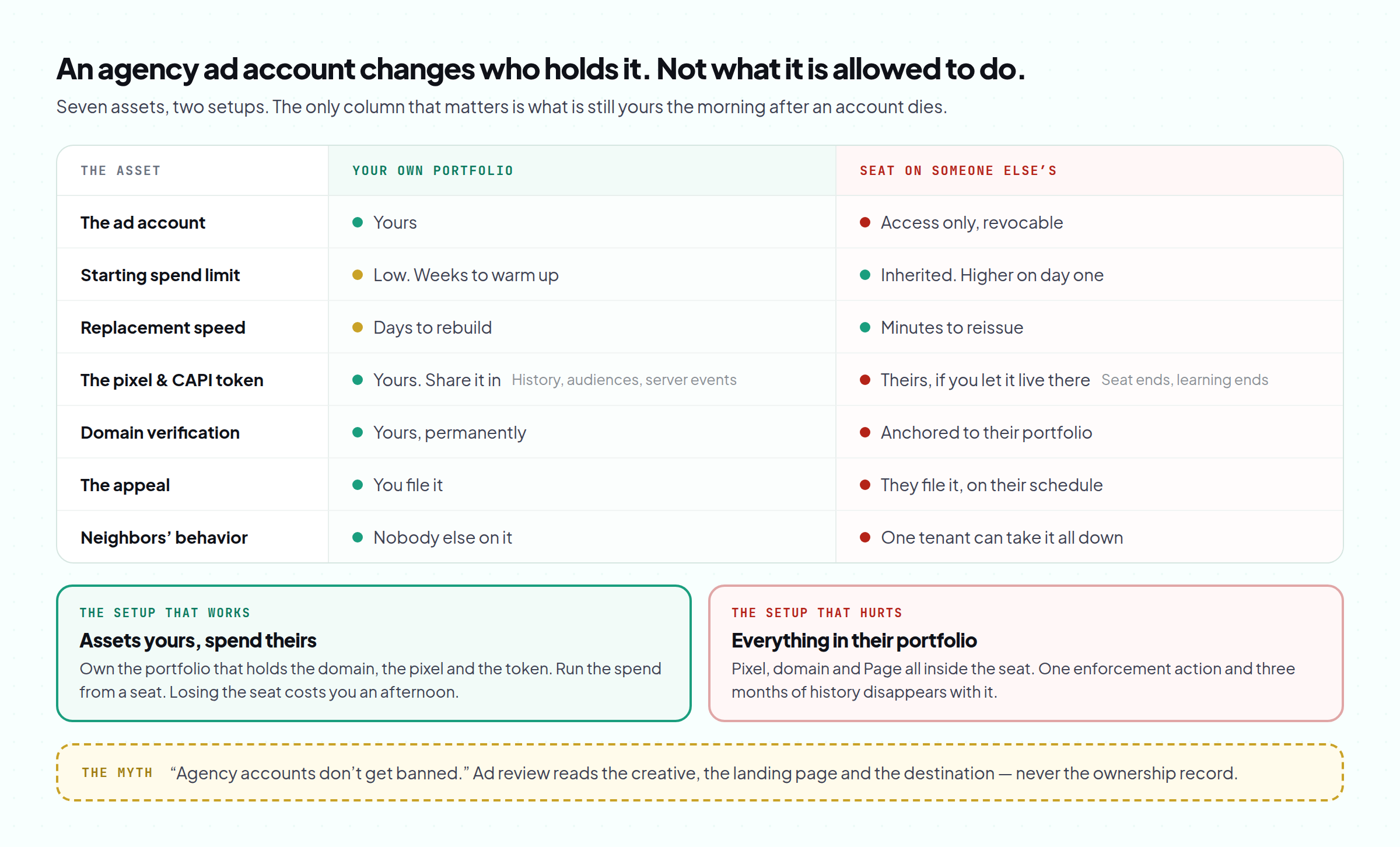
What a facebook agency ad account genuinely gives you:- Replacement speed. The real product. A seat can be reissued in minutes where a fresh portfolio takes days to warm up and weeks to reach a usable limit.
- Inherited standing. A portfolio with spend history starts higher than a new one. This is not a trick; it is how the limits work.
- A buffer between you and the strike. The portfolio takes the hit. Your personal profile is one step further away from the enforcement, which matters because profile-level restrictions are the hardest to come back from.
- Somebody else's billing relationship. Useful if payment methods are where your accounts keep dying · a separate problem covered in Facebook ads payment failed.
- Ownership. Access can be withdrawn by the portfolio owner, with no appeal and no notice.
- Your pixel. If the pixel lives in their portfolio, the data and the audiences are theirs. When the seat ends, the learning ends with it. Where your pixel lives is the single most important decision in this whole setup.
- Immunity. The ad review system does not check who owns the portfolio before it reads your ad.
- An appeal. You cannot appeal an action against an account you do not hold. Someone else does, on their schedule, with their priorities.
- Seats bought10
- Live after onboarding990% of the step before · healthy: 90%+
- Still live at 30 days667% of the step before
- Still live at 90 days467% of the step before
Example numbers for one buyer over a quarter, to show the shape rather than a benchmark. The third number on a line is the healthy minimum. Tap "Use my numbers" to put your own in.
That attrition is the part nobody prices into a facebook agency ad account. If you treat a seat as a permanent asset, that attrition reads as being cheated. If you treat it as a consumable with a half-life, the same numbers are just the cost of staying live, and your planning changes accordingly.
Why a facebook agency ad account still goes down#
Four reasons, in the order they actually happen.
Your ad broke a rule. Review reads the creative, the landing page and the destination. It does not read the ownership record, so a facebook agency ad account is assessed exactly like your own. A claim you cannot substantiate gets actioned in an agency account exactly as fast as anywhere else.
Another tenant broke a rule. On a shared portfolio you inherit your neighbors' behavior. This is the risk that is genuinely unique to seats, it is invisible to you, and no amount of care on your side prevents it.
The portfolio itself got flagged. Everything inside it stops at once. Your campaigns, your spend, your learning phase.
It was used to continue something that was already stopped. This is the one that turns a recoverable situation into a permanent one, and it is worth being very clear about.
If a seller tells you an agency ad account lets you keep running an offer that was already actioned, or that it makes a restricted advertiser's ads deliver again, walk away.
That is circumvention under Meta's advertising policies, and enforcement for it is applied across connected profiles, portfolios, Pages and payment methods rather than to the one account.
People who go that route do not lose an ad account. They lose the whole structure, including the assets they built legitimately.
The honest version of the pitch is narrower and still worth paying for: faster replacement, higher starting limits, less of your own identity in the blast radius.
The setup that makes losing one cheap#
Here is the reframe that changes how much any of this matters. Stop trying to make the account survive. Make losing it boring.
Every facebook agency ad account you run is temporary, and so is every account you own. The only question is whether the things that took real work to build go down with it. Four of them do not have to.
- Your domainVerify it in a business portfolio you own, not the agency's. Domain verification is the anchor everything else hangs off.
- Your pixelKeep it in your own portfolio and share it in. When the seat ends, the data, the history and the audiences stay with you.
- Your Conversions API tokenIt is issued against the portfolio that owns the pixel, so the same rule applies. Lose this and your server-side events stop with the account.
- Your creative and your pageKeep master files and a Page you administer. Rebuilding an ad is an hour. Rebuilding a Page's history is not.
- A warm spareOne account live, one account warm and spending a little. The spare is the whole reason the first one being killed is survivable.
Do this once, before you need it. Every item here takes minutes in advance and days to recover afterward.
Get that right and an account loss costs you an afternoon of rebuilding campaigns. Get it wrong and it costs you the pixel history, the audiences and the domain trust that took three months to accumulate · which is the real reason a dead account feels catastrophic, and the restriction itself is only the trigger.
What a facebook agency ad account costs#
A facebook agency ad account has no fixed market rate, so treat anybody quoting one with suspicion, including anybody quoting one to you in a sales message. What is stable are the variables:
- Spend limit and history. The single biggest driver. An account with real spend behind it costs multiples of a fresh one.
- Seat versus outright. A seat on someone's portfolio is cheaper up front and is rented. A standalone portfolio costs more and is yours.
- Vertical. Accounts intended for grey verticals price higher because they die more often, and anybody pretending otherwise is pricing the wrong risk.
- Replacement terms. The clause that actually matters. Ask what happens when it dies in week two, and get the answer before you pay rather than after.
Whoever you buy from, ask the same four questions: what spend limit it starts at, who owns the portfolio, how many other people are on it, and what happens when it goes down.
What an agency ad account will not fix#
- A policy problem in your creative or landing page. It follows you into every facebook agency ad account you will ever run. New account, same review, same outcome.
- An offer that does not convert. Delivery is not the constraint if the funnel below it leaks, which is covered in high CTR, no conversions.
- A restriction on your personal profile. That sits above every portfolio you touch and has to be resolved on its own terms.
- A measurement blind spot. Running from somebody else's portfolio does not tell you which ad set works. That is a separate build entirely.
The bottom line#
A facebook agency ad account is a rented position inside someone else's standing with Meta. That is genuinely valuable · it is faster to replace, it starts higher, and it puts a layer between your own profile and the next strike. A facebook agency ad account is not armor, though, and the people selling it as armor are selling you the one thing it cannot be.
The question that decides whether it is worth your money is not "will this account survive." It will not, eventually. The question is what is still standing the morning after it dies. If that answer includes your domain, your pixel, your audiences and a warm spare, then an account loss is a scheduling inconvenience. If it does not, you are rebuilding your business every time a reviewer makes a decision about one ad.
So today, before you buy anything, do this. Open the portfolio your pixel currently lives in. If it is not one where you are the admin, that is the first thing to fix · and it costs nothing but ten minutes, which is the best trade available to you in this entire industry.
PS. The tell that someone is selling you the myth rather than the product is that they talk about the account and never about replacement. Ask one question: what happens when it dies in week two? A serious seller has a specific answer. Everybody else changes the subject back to the spend limit.
Frequently Asked Questions
What is a Facebook agency ad account?
Do agency ad accounts get banned?
Is a facebook agency ad account better than your own business manager?
What happens to my pixel if the agency account is removed?
Can an agency ad account get my ads running again after a restriction?
How much does a Facebook agency ad account cost?
Keep reading
Virtual Phone Number for Facebook: The Complete 2026 Business Manager Guide
The number that verified your Business Manager belongs to a stranger by spring. What Meta actually checks, why
Facebook Ads Payment Failed? The Complete 2026 Guide to Fixing It Fast
Either your bank refused the charge or Meta did, and the two need opposite responses. How to tell which in thr
Transfer Facebook Pixel to Another Business Manager: The Complete 2026 Guide
The account died. The pixel did not, unless it lived in the same place. Where pixel data actually lives, how t