
Backup Ad Accounts: The Complete 2026 Guide to Never Going Dark

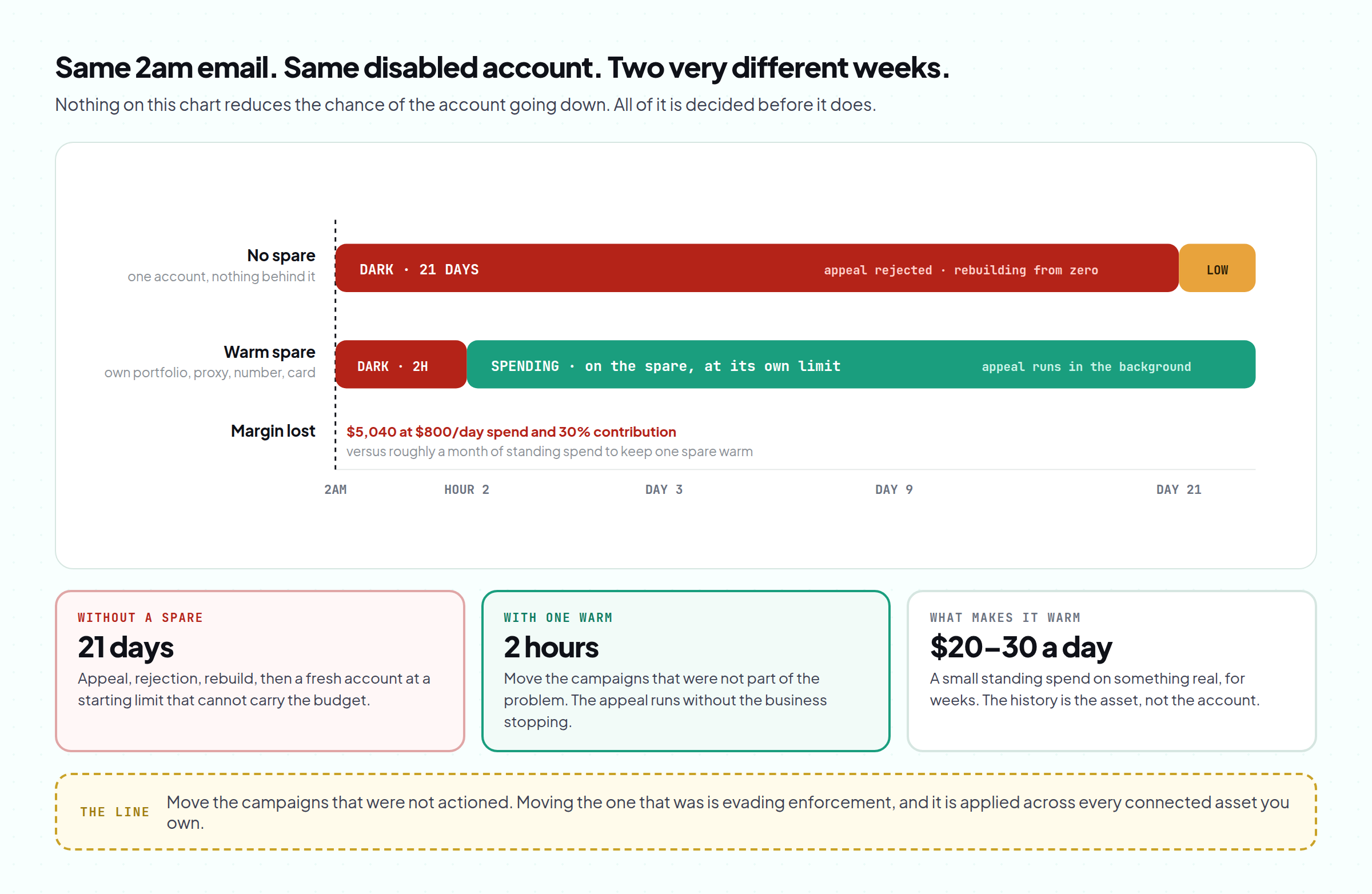
The email lands at 2am and there is nothing to do until the appeal queue moves. Three weeks dark, not because the account died, but because when it died you had nothing else. How many spares the spend you run calls for, and the line you cannot cross.
On this page
- What backup ad accounts actually are
- The line between continuity and circumvention
- How many ad accounts do media buyers need
- What has to be true before the night you need it
- The first 48 hours, in order
- What goes down with the account
- Who does not need backup ad accounts
- What backup ad accounts will not do
- The bottom line
- Frequently Asked Questions
The email lands at 2am.
Your ad account has been disabled. No specific reason, no named ad, a link to a form. The campaign that had finally found its audience after eleven days of learning stopped mid-flight, and the learning went with it.
You file the appeal before you go back to bed. Then you do the thing everybody does on the first morning, which is nothing, because there is nothing to do.
Day three, still nothing. Day six, a rejection with the same template language as the original notice. Day nine you accept that this one is not coming back and start building a new portfolio, which will take two weeks to reach a spend limit you can actually use.
Three weeks dark. Not because the account died. Accounts die. Three weeks dark because when it died, you had nothing else.
That is the entire argument for backup ad accounts, and it has nothing to do with being clever. I want to walk you through where the line sits between a continuity setup and circumvention, how many accounts the volume you run actually calls for, what has to be warm before the night it matters, and the arithmetic that tells you whether any of this is worth paying for.
The short answer: Backup ad accounts are spare, already-warm advertising accounts that let you keep spending while a disabled account sits in an appeal queue.
The product is not immunity, it is a shorter outage: minutes instead of weeks. There is a hard line, and it is not subtle.
Running a spare because an account died for reasons unrelated to your ads is operations.
Running one to keep delivering the same offer that was just actioned is evading enforcement, Meta applies that across connected assets, and it turns a recoverable restriction into a permanent one.
The right number of accounts is set by what an hour of downtime costs you, not by what you can afford to buy.
What backup ad accounts actually are#
Backup ad accounts are exactly what the name says: spare advertising accounts, already created, already verified, already warm, sitting idle so that the hour an active one stops you are not starting from zero.
The word doing the work there is warm. A brand new ad account is not one of your backup ad accounts, whatever the invoice says. It has no spend history, a low daily limit, no trust, and it behaves like a stranger the moment you push real budget through it. Buying one on the morning your main account dies is the same as not having one, except you also spent money.
What makes backup ad accounts genuinely useful is that they have been boring for weeks. A modest daily spend, on a real offer, through its own proxy and its own verified number, with a payment method that has already cleared a charge. That history is the whole asset.
And one thing backup ad accounts are definitely not: a way to keep running something the platform has already stopped.
The line between continuity and circumvention#
This is the part most articles about backup ad accounts skip, and skipping it is how people lose everything at once rather than one account at a time.
Enforcement is not always about your ads. Accounts go down for payment-method problems, for a flagged login from a new country, for a Page issue, for an automated decision that gets reversed on appeal, and sometimes for reasons nobody at Meta will ever explain to you. In every one of those cases, moving your spend to a spare while the appeal runs is an operations decision. Nothing about your advertising has been judged and found wanting.
That is a completely different act from this: your account is actioned for a specific ad, and you move the same ad to a new account to keep it delivering.
Meta treats business assets as a network, not as isolated objects.
Its advertising standards cover evading enforcement and violating networks or associations as their own violations, and the enforcement for them is applied across the connected profiles, portfolios, Pages and payment methods rather than to the one account you used.
So the failure mode is not that your backup gets caught.
It is that the backup, the main account you were trying to protect, the Page, the profile they are both administered from, and the card that paid for both go down together, in one action, with no appeal that treats them separately.
Read that against what you are actually planning.
If the honest description of your plan is "keep the actioned campaign running somewhere else", backup ad accounts are the most expensive possible way to do it.
If it is "keep the business running while an unrelated problem is resolved", you are doing ordinary operations and you should have done it a year ago.
How many ad accounts do media buyers need#
The real answer is not a number, it is a question: how long can you afford to be dark, and what does each hour cost? That is what sets how many backup ad accounts are worth holding.
Run the arithmetic once, because it ends the debate. Take your daily spend and the margin it returns. A buyer spending $800 a day at a 30% contribution margin is producing roughly $240 a day of margin, so a two-week outage is about $3,400 of margin that never existed, before you count the relearning, the dead creative tests, and the pipeline gap your client or your broker notices three weeks later.
Against that, backup ad accounts cost the account itself plus a small standing spend to keep each one alive. The comparison is not close, and it stops being close very early.
| Daily spend | Accounts live | Spares warm | Why |
|---|---|---|---|
| Under $100 | 1 | 0 | A rebuild costs less than keeping a spare warm. Do not buy this yet |
| $100 to $500 | 1 | 1 | One outage pays for the spare several times over |
| $500 to $2,000 | 2 | 1 to 2 | Split by offer or geo, so one action cannot take all delivery |
| Above $2,000 | 2 to 3 | 2 | At this spend, an hour dark is a real number and partial coverage is not enough |
What happens to the business if you cannot spend for two weeks?
Is the account you are replacing down for something your ads did?
A single warm account is the entire difference between three weeks dark and an afternoon. Do not over-build past it.
Go to the fixTwo accounts running concurrently beats one account plus a spare, because you never fully stop.
Go to the fixAt this level the cost of spares is a rounding error against two weeks of nothing.
Go to the fixBelow about $100 a day the rebuild is cheaper than the insurance. Spend the money on the offer.
Go to the fixFix the ad before it touches another account, or the next one dies the same way and the two get connected.
Read that guideThis is what spares are for. Move the spend and let the appeal run.
Read that guideThe second question matters more than the first. The right number of spares is useless if you move a problem into them.
What has to be true before the night you need it#
Backup ad accounts you have to set up during the outage are not backups. Everything below takes minutes in advance and days afterwards, which is the entire point.
- Its own portfolioA spare inside the same business portfolio as the account that died goes down with it. Separate portfolio, or it is decoration.
- Its own proxy and numberThe ones the account was warmed on. Sharing them across accounts is what links the accounts together in the first place.
- Its own payment methodA card already used successfully on that account. A fresh card on a high budget is one of the most reliable ways to trigger a review.
- A pixel you ownKeep the pixel in a portfolio you administer and share it into both accounts, so a lost account costs you campaigns rather than history.
- A small standing spendTwenty or thirty dollars a day on something real. It keeps the account trusted and, more importantly, it proves the account still works before you need it to.
- A Page that is not the only PageIf both accounts run from one restricted Page, you have two accounts and one point of failure.
Do this once. The version of this list you build at 2am is missing at least three items, and you will not notice which three until the morning.
The pixel line is the one people skip and regret. Where your pixel lives decides whether an account loss costs you an afternoon of rebuilding campaigns or three months of audience history, and it is a ten-minute decision made once.
The first 48 hours, in order#
When it happens, the sequence matters more than the speed. Doing step four first is how a one-account problem becomes a portfolio problem.
The last row is the habit that separates people who are down for an afternoon from people who are down every quarter. The moment you use a spare, you are back to having none, and the replacement takes weeks to become useful.
What goes down with the account#
Backup ad accounts solve delivery and nothing else. They do not solve everything the dead account was holding, and the rest of it is often worth more.
- The proxy and the number. A burnt account takes its paired infrastructure with it, so a replacement is a fresh set rather than a swap. The number side of this is the one people improvise worst.
- The pixel history and audiences, if the pixel lived in the portfolio that went down.
- The learning phase. Nothing transfers. The new account starts cold even with identical creative, which is why the spare needs its own history already.
- The spend limit. Inherited standing is the real advantage of an agency account over a fresh portfolio, and it is also what you lose.
Who does not need backup ad accounts#
- Anyone spending under about $100 a day. The rebuild costs less than the insurance. Put the money into the offer.
- Anyone whose accounts die for the same reason every time. Backup ad accounts do not fix a creative or landing page that keeps getting actioned. You will just burn through them faster and connect them to each other on the way.
- Anyone running a single short campaign. If there is nothing after this flight, there is nothing to protect.
- Anyone looking for a way to keep an actioned campaign alive. Covered above, and the consequences are worse than the problem.
What backup ad accounts will not do#
- They will not prevent anything. Backup ad accounts shorten outages. Nothing on this page reduces the chance of the first account going down.
- They will not carry your spend limit across. A spare starts at its own limit, which is why a dormant one is almost useless.
- They will not survive a profile-level action. A restriction on the personal profile that administers everything sits above all of it.
- They will not make an unmeasured funnel measurable. Knowing you are live is not the same as knowing which ad set works, which is a different gap entirely.
The bottom line#
Backup ad accounts are not insurance against an account dying. Nothing is. They are insurance against the three weeks afterwards, and that is the only part of this you actually control.
The cost of getting this wrong is not evenly spread, either. Spend twenty dollars a day and an outage is an inconvenience. Spend a thousand and it is a month of margin, a client conversation you do not want, and a learning phase you get to pay for twice. The number of backup ad accounts that makes sense is a function of that, and nothing else.
Also worth being blunt about the part nobody sells: the most common reason people end up with no delivery at all is not that they had no spare. It is that they had one, moved an actioned campaign onto it, and lost both within a week.
So today, do the cheapest version of this. Open your current setup and answer four questions. Which portfolio is the account in? Which Page does it run from? Where does the pixel live? Which card pays for it? If the same answer appears for everything you run, you do not have a backup plan, you have one account wearing several names.
PS. The tell that you are not actually covered is the sentence "I can just spin up another one". You can. It will take two weeks to be worth anything, and you will be spending those two weeks finding that out.
Frequently Asked Questions
How many ad accounts do media buyers need?
Are backup ad accounts against Facebook's rules?
Does a backup ad account need to be spending money?
Should backup ad accounts be in the same Business Manager?
How long does it take to warm a new ad account?
What is the fastest way back after an ad account is disabled?
Keep reading
Virtual Phone Number for Facebook: The Complete 2026 Business Manager Guide
The number that verified your Business Manager belongs to a stranger by spring. What Meta actually checks, why
Facebook Ads Payment Failed? The Complete 2026 Guide to Fixing It Fast
Either your bank refused the charge or Meta did, and the two need opposite responses. How to tell which in thr
Transfer Facebook Pixel to Another Business Manager: The Complete 2026 Guide
The account died. The pixel did not, unless it lived in the same place. Where pixel data actually lives, how t