
Facebook Ads for Forex Brokers and IBs: Cost per FTD, Step by Step (2026)

How to run Facebook ads for forex brokers and IBs in 2026: getting cleared for finance ads, creative that passes review, and tracking every ad set to the first-time deposit.
On this page
- What do Facebook ads for forex need to work in 2026?
- Step 1: get cleared to run finance ads where you target
- Step 2: write ads that pass finance review
- The funnel behind Facebook ads for forex: from tap to FTD
- Cost per click vs cost per lead vs cost per FTD
- How to track Facebook ads for forex down to the deposit
- Mistakes that burn budget in Facebook ads for forex
- How the Fellows Hub runs this for brokers and IBs
- Judge on cost per FTD, then set the budget
- Frequently Asked Questions
Key takeaway: Facebook ads for forex pay off when you judge them on cost per first-time deposit (FTD), not cost per click or cost per lead. Get cleared to advertise where your market requires it, keep the creative inside Meta's finance rules, track every person from the ad to the deposit, and send the registration and the deposit back to Meta so it learns who is worth finding.
I have run Meta campaigns for broker brands, IBs and trading academies for years. The pattern that costs the most money is always the same: an ad set that looks cheap in Ads Manager and brings almost no deposits. This guide is how I set up Facebook ads for forex now, so the cheap ad set and the profitable one stop hiding behind each other.
It is written for broker marketing teams, introducing brokers (IBs), affiliates and the media buyers who run Facebook ads for forex offers on their behalf.
What do Facebook ads for forex need to work in 2026?#
Facebook ads for forex need three things to work in 2026: an advertiser Meta will let run finance ads in your target countries, creative that passes Meta's finance review, and tracking that follows each person to the first deposit. Miss the first and nothing runs. Miss the second and accounts get restricted. Miss the third and you scale the wrong ad sets.
The order matters. Most teams start with creative and audiences, and only look at tracking once the budget is spent.
Step 1: get cleared to run finance ads where you target#
Meta treats forex, CFDs and other trading products as financial services and reviews them more closely than ordinary ads. Its financial products and services policy is the reference, and some products, such as binary options, are on its prohibited financial products list entirely.
In a growing number of countries, Meta also asks financial advertisers to prove they are authorized by the local regulator before their ads run. The UK (FCA) and Australia (ASIC) are two well-known examples, and the list has been getting longer. Before you plan a campaign:
- List the countries you will target and check each one against Meta's current verification requirements.
- Make sure the business that runs the ads is the one that holds the licence, or is clearly authorized by it.
- If you are an IB or an affiliate, read your broker's partner rules too. Many brokers do not allow partners to run paid ads on the broker's brand name.
Step 2: write ads that pass finance review#
Finance ads get rejected for a short list of reasons, and nearly all of them are promises.
- No income or profit claims. "Make $500 a day" and "double your account" are out, and so are screenshots of P&L.
- No win rates and no "guaranteed" anything.
- No lifestyle shots of cars, watches and beaches that suggest trading made someone rich.
- Nothing that singles out the reader's money problems, such as "drowning in debt?".
- If you are a regulated CFD provider in the EU or the UK, your regulator's risk warning belongs in your marketing, ads included. Use the short form your regulator allows for space-limited formats.
The funnel behind Facebook ads for forex: from tap to FTD#

A forex funnel on Meta usually has six steps: the tap, the landing page, the Telegram channel or the sign-up form, the people who stay, the registration with the broker, and the first deposit. Each step loses people, and each one changes what a result really cost.
- Tapped the ad1,000
- Reached the page85085% of the step before
- Joined the channel30035% of the step before
- Still in at day 79030% of the step before
- Registered with the broker89% of the step before
- First deposit225% of the step before
Illustrative numbers. Tap "Use my numbers" to put in yours.
The drop that hurts most is usually between the channel and the broker. People join for the content, and opening an account is a second decision. That is where the welcome message, a link of their own and a clear reason to register do the work.
Cost per click vs cost per lead vs cost per FTD#
| Metric | What it counts | What it hides | Use it for |
|---|---|---|---|
| Cost per click | Spend per link click | Whether anyone joined | Spotting weak creative |
| Cost per join or lead | Spend per join or form | Whether they stay | An early read |
| Cost per registration | Spend per broker sign-up | Whether they fund | Checking the welcome and the offer |
| Cost per FTD | Spend per first-time deposit | Deposit size over time | Setting the budget |
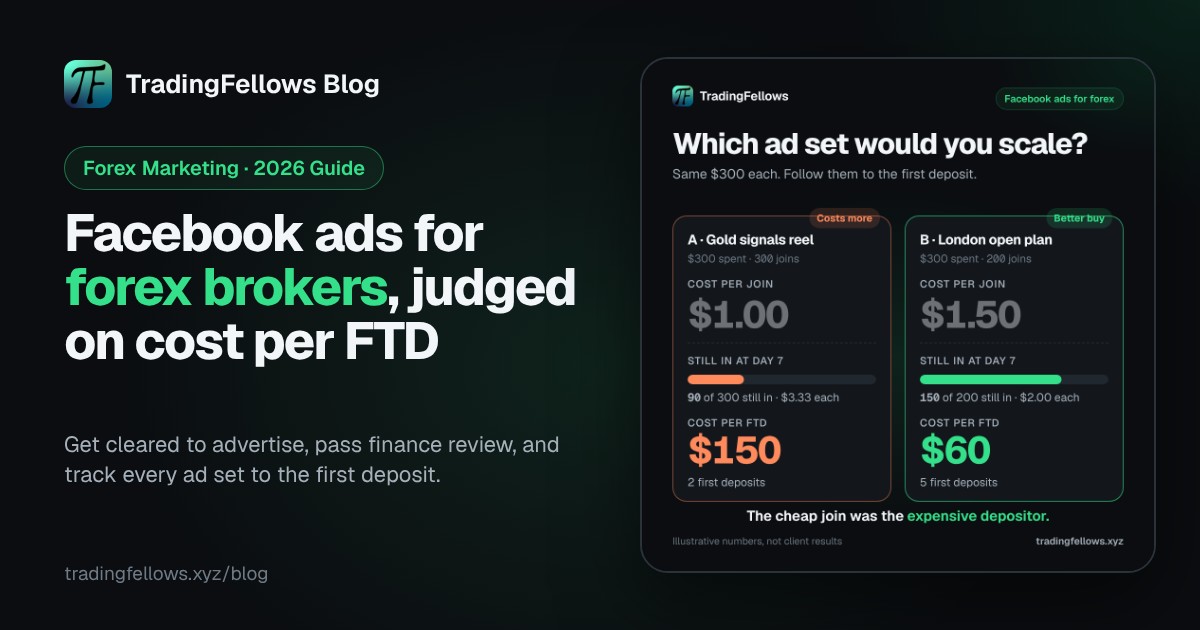
Here is the same comparison with two ad sets. The numbers are illustrative, not client results.

- Gold signals reel: $300, 300 joins, $1.00 per join. 90 still in at day 7. 2 FTDs, so $150 each.
- London open plan: $300, 200 joins, $1.50 per join. 150 still in at day 7. 5 FTDs, so $60 each.
How to track Facebook ads for forex down to the deposit#
- One tracked link per ad set. Every join or sign-up has to carry the ad set that brought it. For a Telegram channel, that means one invite link per ad set.
- A link of their own for each person. When your bot or your page hands each person a personal registration link, the broker sign-up ties back to that person, and through them to the ad set.
- Postbacks from the broker or affiliate network. Broker affiliate platforms usually let you set a postback URL that is called when a referred client registers or makes a first deposit. That call is what closes the loop.
- Send the events to Meta from a server. Through the Conversions API, send the join as Subscribe or Lead, the registration as CompleteRegistration, and the first deposit as Purchase with its value.
- Optimize for the deepest event you have enough of. Meta's learning phase needs about 50 optimization events a week per ad set. If an ad set brings 5 FTDs a week, optimize it for registrations or joins, and judge it on FTDs.
- AdSomeone taps an ad in one of your ad sets.
- PageYour pixel records the visit and the ad set that sent it.
- ChannelThe join carries that ad set's own invite link.
- WelcomeYour bot greets them and hands them a link of their own.
- BrokerThey register and fund through that link.
- PostbackThe broker or network reports the registration and the FTD.
- MetaThe events go back through the Conversions API, so Meta looks for more depositors.
One person, seven steps. The ad set's name stays attached the whole way.

Mistakes that burn budget in Facebook ads for forex#
- Optimizing for link clicks because they are cheaper, then wondering why nobody deposits.
- Sending every ad set to the same public channel link, so no deposit can be traced to an ad.
- Judging a new ad set on day 2, before a deposit could have arrived.
- Running the same campaign in countries with different verification rules, and losing the account in one of them.
- Letting partners run ads on your brand without written rules, then answering for their creative.
- Counting deposits from organic traffic, seeded members or old clients as ad results.
Where does your funnel drop the most?
The ad promises something the page does not say. Repeat the one-line offer on the page and keep one button.
Go to the fixFix the welcome, the pinned guide and the posting rhythm before you buy more traffic.
Read that guideGive each person a link of their own and a clear reason to open an account, in the welcome and in your posts.
Go to the fixStart with one link per ad set and broker postbacks, then look again in two weeks.
Go to the fixHow the Fellows Hub runs this for brokers and IBs#
I built the Fellows Hub because running Facebook ads for forex this way used to take a copy tool, a page builder, a tracker, a bot and a spreadsheet. In the Hub it is one place.
- Fellows AI writes the ads from one line and checks every line against Meta's finance rules before you see it. Income claims, win rates and "guaranteed" get flagged.
- Pages hosts the landing page with your pixel, checked every 5 minutes.
- Channels gives every ad set its own link, counts joins and who is still in at day 7, and takes registrations and deposits from your broker's postback.
- Your bot greets each person before they are let in and hands them a link of their own.
- Pass it on sends joins, registrations and deposits back to Meta.

Judge on cost per FTD, then set the budget#
Facebook ads for forex are not won on the cheapest click. Get cleared where you advertise, keep the creative free of promises, track every person to the deposit, and tell Meta about the registrations and deposits so it can find more of them.
If you want all of that in one place, see the Fellows Hub at tradingfellows.xyz. Questions go to the operator on Telegram: t.me/TradingFellowsAds.
Frequently Asked Questions
Are Facebook ads for forex allowed?
What is a good cost per FTD for Facebook ads for forex?
Can an IB run Facebook ads for a broker?
Should forex ads go to a Telegram channel or a landing page?
How long should I wait before judging an ad set?
Keep reading
Telegram Ads for Forex | How Brokers and Affiliates Actually Generate Leads in 2026
There are three ways to run telegram ads for forex: the official Telegram Ads platform, paid placements in exi
Telegram Invite Link Tracking: How to Track Every Ad Set in 2026, Step by Step
How to give every ad set its own Telegram invite link, what Telegram counts for free, and how to track who is
Forex Signals Telegram Channel: How to Run Ads That Pass Review (2026)
What each platform allows for a forex signals Telegram channel, how to write ads that pass review, and how to