
Cost per FTD: What It Is, How to Calculate It and How to Lower It (2026)

What cost per FTD means, how to calculate it per ad set with a free calculator, why it beats cost per lead, and six changes that bring it down.
On this page
- What is cost per FTD?
- How do you calculate cost per FTD?
- Why is cost per FTD better than cost per lead?
- What is a good cost per FTD?
- How do you lower your cost per FTD?
- How does cost per FTD work with CPA, revenue share and hybrid deals?
- Cost per FTD mistakes to avoid
- Measure it per ad set, then scale on it
- Frequently Asked Questions
Key takeaway: Cost per FTD is your ad spend divided by the number of first-time deposits it brought. It is the number a broker, an IB or an affiliate is actually paid on, so it is the one to scale on. To lower it, fix what happens after the click: track every ad set to the deposit, send the deposit back to Meta, and plug the gap between the join and the registration.
- Cost per FTD = ad spend divided by the first-time deposits it brought, in a fixed window after the click.
- It is the number brokers, IBs and affiliates are paid on, so it is the one to scale on.
- Calculate it per ad set, per country and per creative, not only for the whole account.
- Judge it against what an FTD pays you: the CPA, the revenue share, or the lifetime value.
- To lower it, track every ad set to the deposit, send deposits back to Meta and fix the handoff from join to registration.
Most forex campaigns are reported on cost per click or cost per lead, because those are the numbers the ad platform hands you. The business is paid on something else: first-time deposits. When the two numbers are far apart, budget goes to the ad sets that look cheap and away from the ones that make money.
This guide explains cost per FTD in plain terms, shows how to calculate it, with a calculator you can fill in, and lists the changes that bring it down. It is written for broker marketing teams, introducing brokers (IBs), affiliates and the media buyers who work with them.
What is cost per FTD?#
Cost per FTD is the total you spent to acquire first-time depositors, divided by the number of first-time depositors (FTDs) you got. An FTD is a new client who funds a trading account for the first time. If you spend $3,000 and get 20 FTDs, your cost per FTD is $150.
The definition is simple. Two details make it useful:
- Count only what the spend brought. Organic sign-ups, old clients coming back and deposits from other partners do not belong in the number.
- Use the same window every time. Deposits arrive days or weeks after the click, so decide whether you count FTDs within 7, 14 or 30 days of the click, and keep it.
- FTD: a first-time deposit, or the client who made it.
- Qualified FTD: an FTD that meets the deal's conditions, such as a minimum deposit or trading activity, and gets paid.
- CPA: in an affiliate or IB deal, the fixed amount the broker pays per qualified FTD.
- Cost per lead: spend divided by sign-ups or registrations, before anyone deposits.
- Counting window: how many days after the click a deposit still counts toward the ad.
How do you calculate cost per FTD?#
To calculate cost per FTD, divide the ad spend by the number of first-time deposits it brought within your counting window. The formula is spend divided by FTDs. In practice you calculate it per ad set, per country and per creative, because the average hides the ad sets that lose money.
Read "lead" as a registration with the broker and "customer" as a first-time depositor. Cost per customer is your cost per FTD. Put in your own numbers.
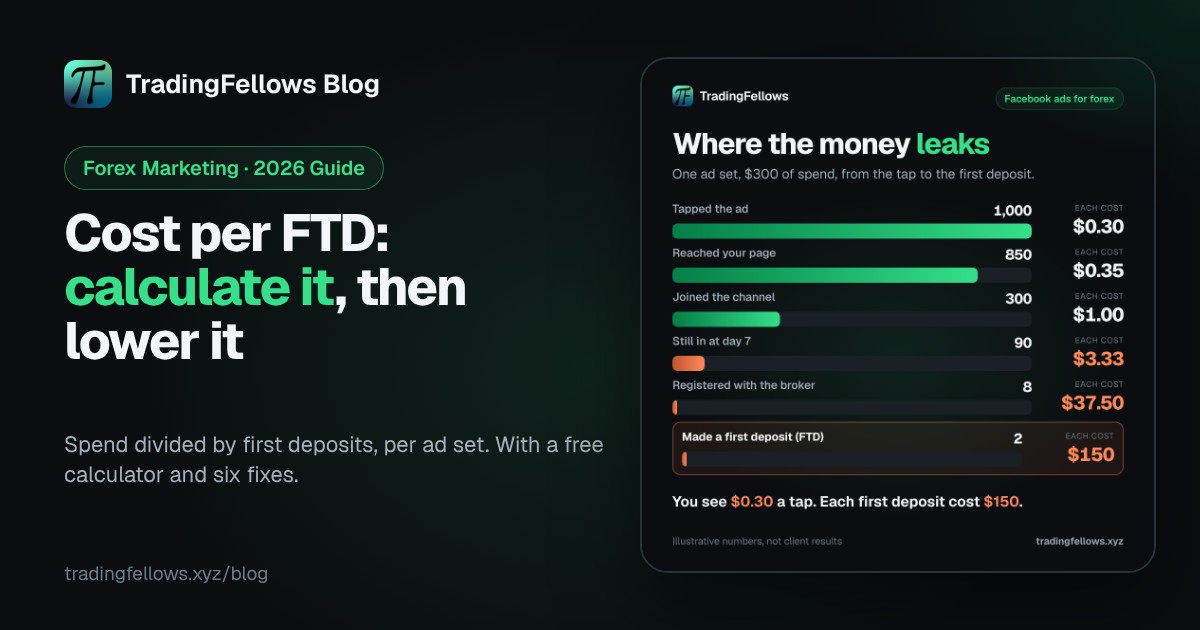
Here is the same funnel step by step, with illustrative numbers for one ad set:

| Step | People | Cost per person |
|---|---|---|
| Tapped the ad | 1,000 | $0.30 |
| Joined the channel or signed up | 300 | $1.00 |
| Still there at day 7 | 90 | $3.33 |
| Registered with the broker | 8 | $37.50 |
| First deposit | 2 | $150 |
Why is cost per FTD better than cost per lead?#
Cost per FTD is better than cost per lead because it measures what the business is paid on. Cost per lead is useful early, but it rewards the wrong ad sets. A cheap lead who never funds an account is not cheap.
- Leads are easy to inflate. Broad audiences, incentives and short forms all lower cost per lead and often lower deposit rates with it.
- Meta learns from what you report. If the last event Meta hears about is the lead, it finds more people who leave their details, not more people who fund.
- Deals are paid on deposits. Most broker and affiliate deals pay on a qualified FTD, by CPA, revenue share or a mix of both. Your cost per FTD is what you compare against that payout.

The ad set with the cheaper join brought 2 FTDs at $150 each. The "expensive" one brought 5 at $60 each. On cost per lead you would scale the wrong one. I go deeper on the early signal in cost per Telegram subscriber.
What is a good cost per FTD?#
A good cost per FTD is one comfortably below what an FTD pays you. For an affiliate or IB, that ceiling is the CPA or the expected revenue share per FTD. For a broker, it is what a first-time depositor is worth over time.
For scale, typical forex CPA payouts are often quoted from around $200 to over $1,000 per qualified FTD, depending on the country, the account size and the broker, according to Track360's CPA vs revenue share glossary. Treat that as a planning range, not a benchmark for your campaign: your own payout terms and your own ad sets are the only fair comparison.
How do you lower your cost per FTD?#
To lower your cost per FTD, track every ad set to the deposit, send the deposit back to Meta, and fix the handoff from the channel or page to the broker. These are the changes that move it the most, in the order I make them.
- Track every ad set to the deposit. One tracked link per ad set, and a link of their own for each person, so a registration and a deposit land on the ad set that brought them. Without this, cost per FTD can only be calculated for the whole account.
- Get postbacks from the broker or network. A postback is a call the broker or affiliate platform makes when a referred client registers or deposits. It turns a monthly report into a number you can act on this week.
- Send the deposit back to Meta. Through the Conversions API, report the registration and the first deposit, so Meta looks for depositors instead of clickers. The setup is in Facebook ads for forex brokers.
- Plug the handoff. In most funnels the biggest drop is between joining a channel and registering with the broker. A clear welcome message, a personal registration link and a reason to open an account that is about the trader do more than a new hook.
- Judge on day 7, decide on FTDs. Members still in a channel at day 7 are the earliest signal of who will deposit. Read it first, then confirm with cost per FTD once deposits have had time to arrive.
- Cut by cost per FTD, not by cost per lead. Once you have a few weeks of data, move budget from the ad sets with the highest cost per FTD to the lowest, even if their cost per lead says the opposite.
Where does the funnel drop the most?
The ad promises something the page does not say. Repeat the one-line offer on the page and keep one button.
Read that guideFix the welcome, the pinned guide and the posting rhythm before buying more traffic.
Read that guideGive each person a link of their own and a clear reason to open an account.
Go to the fixStart with one link per ad set and broker postbacks, then look again in two weeks.
Go to the fixHow does cost per FTD work with CPA, revenue share and hybrid deals?#
How you judge cost per FTD depends on how you are paid.
| Deal | How it pays | What to compare cost per FTD against |
|---|---|---|
| CPA | A fixed amount per qualified FTD | The CPA payout, after rejected or unqualified FTDs |
| Revenue share | A share of what the client generates over time | The expected revenue share per FTD over a set period |
| Hybrid | A smaller CPA plus a revenue share | The CPA now plus the expected share later |
| In-house broker | You keep the client | What an FTD is worth to you over its lifetime |
Cost per FTD mistakes to avoid#
- Mixing organic and paid FTDs in the same number.
- Changing the counting window from report to report.
- Judging a new ad set before any deposit could have arrived.
- Comparing cost per FTD across countries with very different deposit sizes as if they were the same.
- Counting FTDs that the broker later rejects as unqualified.
Measure it per ad set, then scale on it#
Cost per FTD is the number that connects your ads to the money. Calculate it per ad set, get the deposits back from the broker, tell Meta about them, and fix the handoff before you buy more traffic.
If you want every ad set tracked to the deposit in one place, see the Fellows Hub at tradingfellows.xyz. Questions go to the operator on Telegram: t.me/TradingFellowsAds.
Frequently Asked Questions
What does FTD mean in forex?
How do you calculate cost per FTD?
What is a good cost per FTD?
Is cost per FTD the same as CPA?
What is the difference between cost per lead and cost per FTD?
What is a qualified FTD?
How can I lower my cost per FTD?
How long should I wait to measure cost per FTD?
Keep reading
Telegram Ads for Forex | How Brokers and Affiliates Actually Generate Leads in 2026
There are three ways to run telegram ads for forex: the official Telegram Ads platform, paid placements in exi
Telegram Invite Link Tracking: How to Track Every Ad Set in 2026, Step by Step
How to give every ad set its own Telegram invite link, what Telegram counts for free, and how to track who is
Forex Signals Telegram Channel: How to Run Ads That Pass Review (2026)
What each platform allows for a forex signals Telegram channel, how to write ads that pass review, and how to