
Virtual Card for Facebook Ads: The Complete 2026 Guide to Not Getting Declined

Your campaign stopped at 1:40am. Declined by a card with $180 on it, at the moment Meta tried to take $250. Most virtual card failures have nothing to do with the card being virtual.
On this page
- What a virtual card for facebook ads has to survive
- The billing threshold is why your card keeps dying
- Which card type actually fits
- Why a virtual card gets declined when the balance is fine
- The top-up discipline that prevents most of this
- What a decline actually costs
- Who should not use a virtual card for facebook ads
- What a virtual card will not do
- The bottom line
- Frequently Asked Questions
Your campaign stopped at 1:40 in the morning.
Not paused by you. Not actioned by Meta. Declined, by a card with a hundred and eighty dollars sitting on it, at the exact moment Meta tried to take two hundred and fifty.
You find out at breakfast. You top the card up, the ads restart, and you tell yourself that was annoying but fine. It was not fine. The ad set that was eleven days into learning spent the night switched off, the delivery system noticed, and the cost per result for the rest of the week will quietly be worse than it was on Tuesday.
Then it happens again two weeks later, at a higher number, because the thing that charged you two hundred and fifty will eventually try to charge you five hundred.
Here is what almost nobody explains, and it is the whole article in one sentence: most problems with a virtual card for facebook ads have nothing to do with the card being virtual. They happen because Meta's billing threshold climbs as you spend and a prepaid balance does not climb with it.
I want to walk you through the three gates a card has to pass, why the threshold ladder breaks prepaid cards specifically, which card type fits which situation, and the one practice in this corner of the industry that is worth refusing outright.
The short answer: A virtual card for facebook ads has to clear three separate gates, and people usually blame the wrong one.
First acceptance, where the issuer type and country have to be something Meta will take.
Second authentication, where 3-D Secure has to be completable on a card you may not get prompts for.
Third, and most commonly missed, the billing threshold, which steps up as you spend successfully, so a card that worked at a hundred dollars fails at five hundred without anything having changed.
Keep the balance above the next threshold rather than above yesterday's charge, use one card per ad account, and never use a card issued to somebody else.
What a virtual card for facebook ads has to survive#
A virtual card for facebook ads is not one test. It is three, in sequence, and the failure message you get rarely tells you which one you failed.
Gate one: acceptance. Meta has to accept your virtual card for facebook ads at all. This is about what kind of card it is and where it was issued, and it is decided before any money moves.
Gate two: authentication. The charge has to clear 3-D Secure, the protocol that lets your card issuer challenge a card-not-present transaction. The issuer may ask for a one-time code or a push approval, and if you cannot receive and answer that prompt, the charge fails even though the money is there.
Gate three: the threshold. Meta does not charge you per click. It accrues spend and charges at a threshold, and that threshold rises as you successfully pay. This is the gate that kills prepaid cards, and the one almost no guide mentions.
Most people spend a week on gate one when they failed at gate three, which is why a virtual card for facebook ads gets blamed for something it did not do.
The billing threshold is why your card keeps dying#
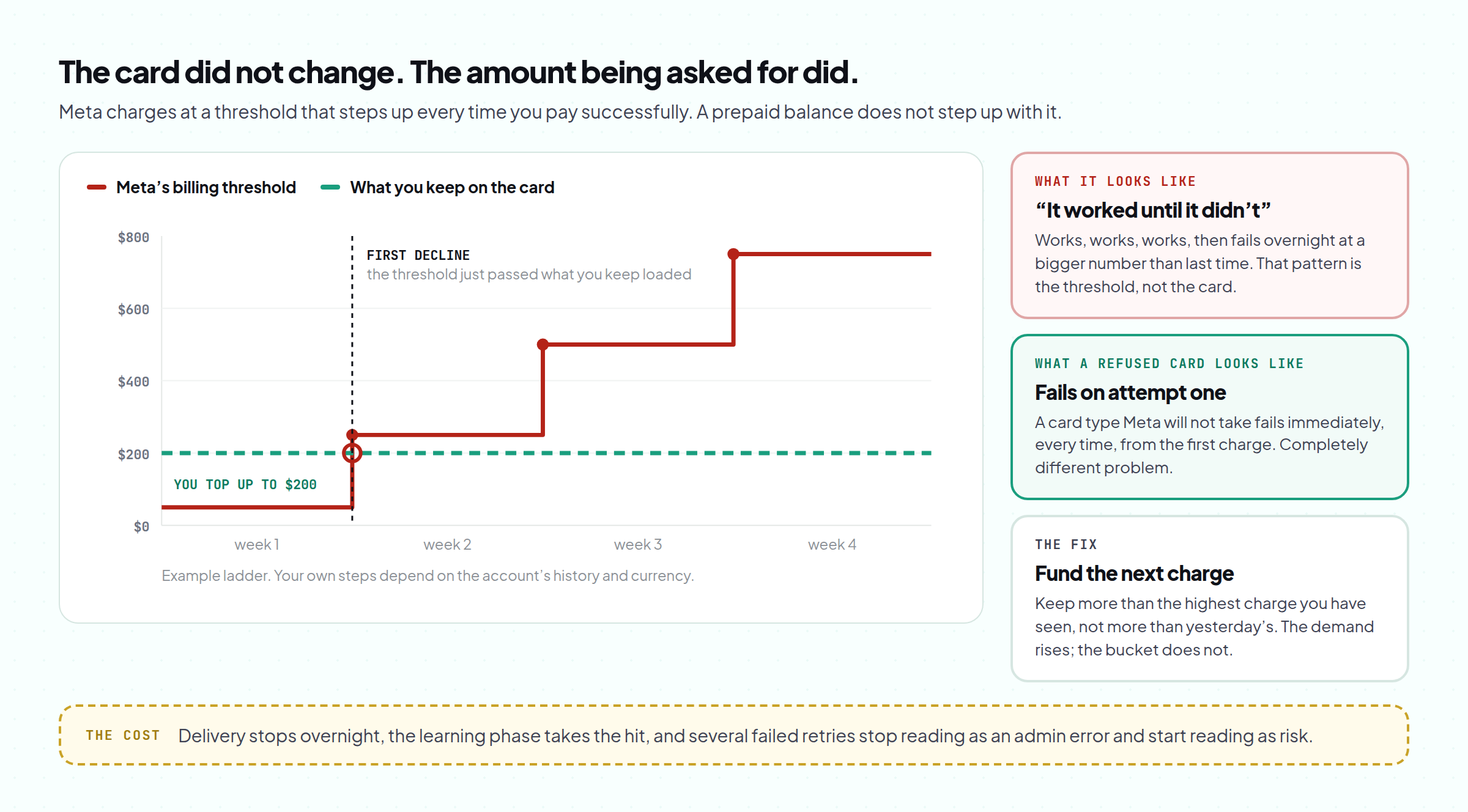
Meta bills on a rolling threshold. You spend, the balance accrues, and when it reaches the threshold it attempts a charge. Pay successfully and the threshold goes up, so the next attempt is for more money. Pay successfully again and it goes up again.
That mechanism is fine on a credit card and lethal on a prepaid virtual card for facebook ads, because your funding is static and the demand is not. The pattern looks like this, and it is almost always misdiagnosed as a card problem:
- Week oneThreshold is low. You load the card, the first charges clear easily, everything feels solved.
- Week twoEach successful payment raises the threshold. You do not see this happen and nothing tells you.
- Week threeThe threshold is now above what you habitually top up. You are one charge away from a decline and the account looks perfectly healthy.
- The declineMeta attempts the charge, the card has less than it needs, delivery stops. Usually overnight, because that is when the accrued spend crosses the line.
- The retryMeta retries, and each failed attempt is a signal on the account. Several in a row stops being a billing event and starts being a risk event.
Nothing about the card changed. The amount being asked for did. This is the single most common reason a virtual card for facebook ads stops working.
The fix is a habit rather than a product: top up against the next threshold, not against yesterday's charge, and keep a buffer above it. If you cannot see your current threshold, assume it is higher than the last successful charge and fund accordingly.
Which card type actually fits#
Four kinds of virtual card for facebook ads get used and they fail in different places. Pick by which gate is your actual problem.
| Card type | Clears acceptance | Clears 3DS | Survives the threshold ladder |
|---|---|---|---|
| Business debit or credit from your own bank | Reliably | Yes, you get the prompts | Yes, this is what the system expects |
| Fintech virtual card issued to you (business account) | Usually | Yes, in the app | Yes, if the account is funded |
| Generic prepaid or gift-style virtual card | Often refused outright | Frequently cannot | No. This is where most failures live |
| Card issued with the ad account by a supplier | Yes, it was set up for it | Depends on the issuer | Only if you keep topping it up |
Do you have a real business bank account in the country the ad account is registered to?
Can you receive the issuer's authentication prompts yourself?
A business card from the matching country clears all three gates with no effort. Virtual cards exist to solve a problem you do not have.
Go to the fixSame effect, ringfenced funds, and the 3DS prompts land in an app you control.
Go to the fixIt cleared acceptance when it was set up. Your only real risk is the threshold ladder.
Go to the fixYou will clear 3DS. Keep one card per ad account and fund above the next threshold.
Go to the fixA card whose authentication you cannot complete will fail at the worst moment, and a card that is not yours should not be on your account at all.
Go to the fixThe first question ends this for most people. The honest answer is often that you do not need a virtual card at all.
Why a virtual card gets declined when the balance is fine#
Threshold aside, these are the reasons a virtual card for facebook ads gets refused, roughly in order of how often they turn out to be the answer.
The issuer type is refused. Many prepaid and gift-style BIN ranges are simply not accepted as a virtual card for facebook ads billing. Nothing you do at your end changes that.
3-D Secure cannot be completed. The issuer challenges the charge, the prompt goes somewhere you are not watching, and it times out. Common with cards issued through a third party.
The billing country does not match. Your ad account has a country and a currency set at creation, and a mismatch between that and the card's issuing country is a risk signal. The fix is to get them consistent, which sometimes means a new ad account rather than a new card. It does not mean misstating where you are.
The card is new and the spend is high. A card added today and immediately asked for a large charge is one of the most reliable ways to attract a review, the same way a freshly added phone number on a high-spend account is. Add the card, let it clear something small, then raise budgets.
One card is paying for several accounts. Beyond the decline risk, one virtual card for facebook ads across several accounts is how they become connected in Meta's eyes, which matters enormously the day one of them is actioned. Backup accounts share nothing or they are not backups.
If the decline has already happened and you are trying to work out whether it is your bank or Meta, that diagnosis is its own guide: Facebook ads payment failed.
There is a practice in this corner of the industry of choosing cards by BIN so that the card appears to be issued in a country you are not in, and of running cards that were issued to somebody else.
The first is misrepresentation.
You are not optimizing a payment route, you are making the account look like something it is not, and when it unwinds it does not unwind as a billing problem.
It unwinds as an integrity problem across every connected asset, which is a far more expensive category than a declined charge.
The second is worse and simpler. A card issued to another person, used without them, is fraud.
It is not a grey area, it is not a growth tactic, and no amount of ad spend justifies it.
Anyone selling you card details rather than a card issued for you is selling you a liability with a chargeback attached.
The legitimate version is dull and it works: a card issued to you or your business, in a country consistent with the account, with authentication prompts you personally receive.
The top-up discipline that prevents most of this#
Four habits that keep a virtual card for facebook ads alive. None of them cost anything.
- Fund against the next threshold, with a buffer. If your last successful charge was $250, assume the next one is larger and keep meaningfully more than that available.
- One card, one ad account. Both for decline risk and because shared payment methods link accounts together.
- Change one thing, then retry once. Four rapid retries on a failing card turns a payment event into a risk event. Fix the cause, retry a single time.
- Add the card before you need it. A payment method that has already cleared a small charge is in a completely different position from one added during an outage.
What a decline actually costs#
With a virtual card for facebook ads, the charge failing is the small part.
Delivery stops. Usually overnight, and the ad set that was learning loses its momentum rather than pausing neatly.
Repeated failures become a signal. A string of declines reads as risk, not as an admin error, and it can escalate past billing into a restriction on the account.
The replacement is not instant. Adding a new card during an outage puts a brand new payment method on an account that is already under scrutiny, which is the worst possible moment to introduce one.
That compounding is the real argument for getting this boring and right, and it is the same argument as the one for holding a spare account: the cost is never the incident, it is the hours afterwards.
Who should not use a virtual card for facebook ads#
- Anyone with a working business card in the right country. Use it instead of a virtual card for facebook ads. A virtual card for facebook ads solves a problem you do not have, and adds a failure mode you did not have either.
- Anyone who cannot receive their own 3DS prompts. You will clear charges until the day the issuer decides to challenge one, and then you will not.
- Anyone funding several accounts from one card. Fix that first. It is a bigger risk than the decline you are trying to avoid.
- Anyone who would need a card in someone else's name to make this work. Covered above, and the answer is no.
What a virtual card will not do#
- It will not raise your spend limit. The spend limit and the billing threshold are different things, and no virtual card for facebook ads changes the first one.
- It will not repair a restricted account. A restriction is not a billing state, and a new card does not clear it.
- It will not hide anything. Payment method is one signal among many, and treating it as a disguise is how people lose the account and the balance together.
- It will not survive neglect. A prepaid card is a bucket with a hole that widens every time you pay successfully.
The bottom line#
A virtual card for facebook ads is a funding instrument, not a workaround, and almost every story about one that "stopped working" is really a story about a threshold that climbed while the balance stood still.
Which makes the fix for a virtual card for facebook ads unglamorous. Know roughly what the next charge will be and keep more than that available. Use one card per account. Put the card on before you need it, in a country consistent with the account, with authentication prompts that reach you rather than somebody else. That is the entire discipline, and it prevents the overwhelming majority of what gets blamed on card type.
The part that is worth being firm about: the practices that promise to make a card look like something it is not are not payment optimization. They convert a thirty-second billing problem into an integrity problem that takes the connected assets with it, and a card in another person's name is simply fraud.
So today, before the next charge lands, go and look at two numbers: what your last successful charge was, and what is currently available on the card paying for it. If the second is not comfortably larger than the first, you already know when your campaign is going to stop, and it will be at about one in the morning.
PS. The tell that you are on the threshold ladder rather than a card problem is the pattern. It works, then it works, then it works, then it fails at a bigger number than last time. A card Meta will not accept fails immediately, every time, from the first attempt. A card that is simply running out fails later and larger each time.
Frequently Asked Questions
Can you use a virtual card for Facebook ads?
Why does my virtual card keep getting declined on Facebook ads?
What is the best card for Facebook ads?
How much should I keep on a prepaid card for Facebook ads?
Can one card be used for multiple ad accounts?
Does changing the card fix a restricted ad account?
Keep reading
High CTR No Conversions on Facebook Ads? The Complete 2026 Diagnosis
Your best-CTR ad set produced nothing, so you rewrote the page. If most billed clicks never became visits, non
Virtual Phone Number for Facebook: The Complete 2026 Business Manager Guide
The number that verified your Business Manager belongs to a stranger by spring. What Meta actually checks, why
Facebook Ads Payment Failed? The Complete 2026 Guide to Fixing It Fast
Either your bank refused the charge or Meta did, and the two need opposite responses. How to tell which in thr