
Do Residential Proxies Work for Facebook Ads? The 4 Signals Yours Could Not Fix
You did the research. You worked out that datacenter IPs get flagged. You bought a residential proxy from a reputable provider, set up a clean Business...
On this page
- Do residential proxies actually work for Facebook ads?
- Why did my account get banned even with a residential proxy?
- What does a coherent identity actually look like?
- Which residential proxy type should you use?
- Does a proxy fix an account that was already flagged?
- Is a residential proxy enough on its own?
- The bottom line
- Frequently asked questions
- Do residential proxies work for Facebook ads?
- Why did my Facebook account get banned with a residential proxy?
- Should I use static or rotating residential proxies for Facebook ads?
- Can a proxy unban a Facebook ad account?
- Does the proxy country need to match my business country?
- How many Facebook ad accounts can I run on one residential proxy?
You did the research. You worked out that datacenter IPs get flagged. You bought a residential proxy from a reputable provider, set up a clean Business Manager behind it, and the account died anyway.
So now you are in a forum somewhere reading that residential proxies do not work for Facebook ads.
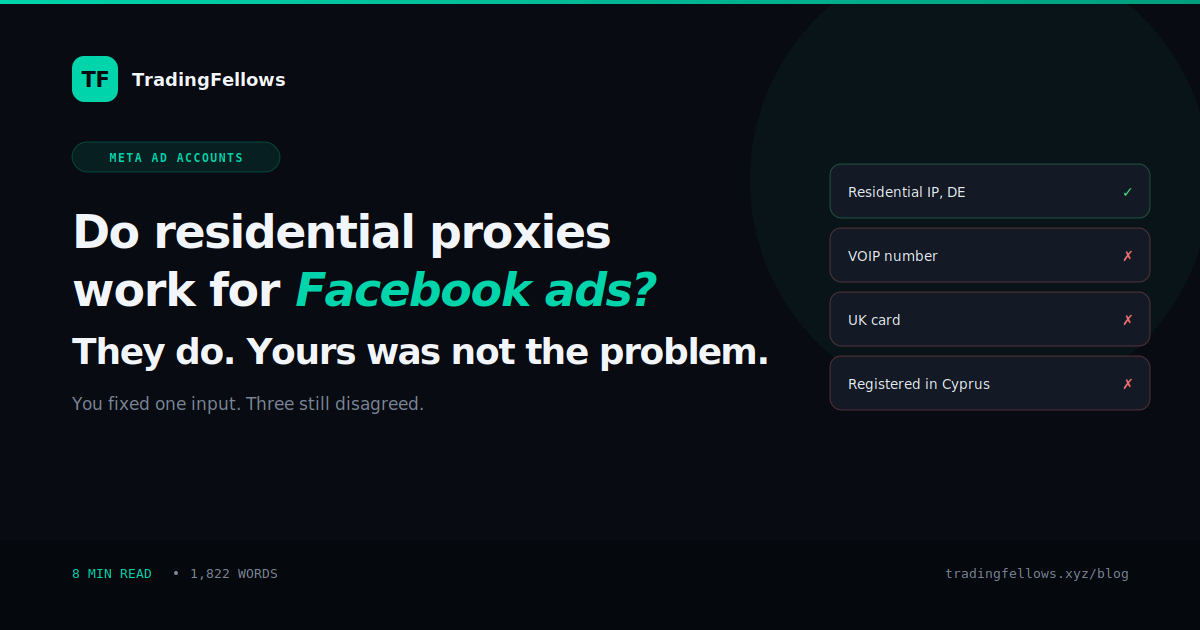
Residential proxies do work. Yours did its job. The problem is that you fixed one input in a system that scores four of them together, and three of yours still disagreed with each other.
Residential proxies work for Facebook ads and they meaningfully reduce risk compared to datacenter or VPN IPs. They do not work in isolation. Meta scores the IP alongside the phone number, the payment card and the browser fingerprint, and checks whether those inputs describe one coherent identity. A residential IP in Germany attached to a UK card on an account registered in Cyprus is still three mismatches. The proxy was never the whole answer.
Do residential proxies actually work for Facebook ads?#
Yes. Residential proxies route through IPs assigned by consumer internet providers and looks like ordinary household traffic, which is exactly what Meta expects from a real person. Datacenter IPs belong to servers and correlate strongly with automation. Commercial VPN exit nodes are worse still, because thousands of unrelated accounts share the same address and some of them were banned.
Switching from a datacenter IP to residential proxies is a genuine improvement. It is just not sufficient on its own, which is why so many people conclude it does nothing.
Why did my account get banned even with a residential proxy?#
Because the IP is one of four signals scored together. Meta evaluates the IP, the phone number used to verify the account, the payment method attached and the browser fingerprint behind the machine. What matters is not the quality of each input individually but whether the set describes a coherent identity. Fixing one while leaving three mismatched does not change the conclusion.
Here is the version that costs people the most money.
A UK card. An account registered in Cyprus. Accessed from a German residential IP.
Three valid things. Every one of them fine on its own. The proxy is genuinely residential, the card is genuinely valid, the business registration is genuinely real.
Together they describe a person who does not exist.
That set is what gets scored. Not the proxy.
People upgrade the input they read about most and leave the others untouched. They buy the residential proxy, keep the same VOIP number, keep the same card from the wrong country, and set the account up in the same browser profile the last banned one lived in. Then the account dies and the proxy takes the blame, because it was the thing they changed.
What does a coherent identity actually look like?#
The four signals should agree on country, on identity, and on plausibility. That means a residential IP in the country the business operates from, a real carrier mobile number rather than VOIP, a payment card whose name and issuing country match the account, and a browser profile with no history of previously banned accounts.
| Signal | Coherent | Common mismatch |
|---|---|---|
| IP | Residential, business country | Residential, wrong country |
| Phone | Real carrier mobile, stays active | VOIP or disposable SMS |
| Card | Name and country match the account | Right person, wrong country |
| Browser | Clean profile, no ban history | Same machine as last account |
| Business registration | Matches the card and the IP | Registered where neither is |
Which residential proxy type should you use?#
Static residential, also called ISP proxies, are the right choice for advertising accounts. They give you a consistent IP that stays the same across sessions, which matches how a real business behaves. Rotating residential proxies change your IP frequently, and an account that appears from a different address every session looks like exactly the thing Meta is watching for.
This trips up a lot of people, because rotating residential proxies are the default product most providers push. It is built for scraping, where changing addresses is the point. For an ad account you want the opposite.
A few practical points:
- One IP per account. Shared IPs link accounts together, and a ban on one can reach the others.
- Match the country to your business registration, not to your target market. The account should look like it operates from where it says it operates from.
- Keep the IP consistent. Changing your address every login is itself a risk signal.
- Check the IP is not already burned. A residential IP that has been resold repeatedly may already carry history from previous users.
If every item on that list is true and the account still went down, then it probably was not the setup. That usually means you are in a restricted vertical where restriction is a matter of policy, which is a different problem with a different answer.
Does a proxy fix an account that was already flagged?#
No. Moving an existing account behind a residential proxy after it has been restricted does not clear the flag, because the score was already assigned based on how the account was created and used. Proxies affect how a new account is evaluated. They do not retroactively change the history of an old one.
This is worth stating plainly because a lot of money gets wasted on it. People buy a proxy after the ban, log the dead account in through it, and expect a different outcome. The account is scored on everything it has ever done, not on where you logged in from this morning.
Residential proxies matter at creation. After a restriction, what you need is a properly built new account, not a new address for the old one.
Built on a residential IP with a real phone and matched card so the four signals agree from the start, then warmed with seven days of clean spend. Delivered within 24 hours with a replacement guarantee.
Is a residential proxy enough on its own?#
No. A residential proxy removes one risk signal from a set of four. It is a necessary component rather than a complete solution, and the accounts that survive are the ones where every input tells the same story. The proxy matters most when the phone, card and browser are already coherent, and matters least when they are not.
The useful way to think about it: the proxy is not what keeps the account alive. It is what stops one specific thing killing it. There are three others.
For the full picture of what gets scored and why, the breakdown of what Meta checks at account creation covers all four signals rather than just this one.
The bottom line#
Residential proxies work. The reason yours did not is that you changed the input you had read about and left three others describing a different person.
Get the four to agree. Same country, same identity, a phone that still answers in six weeks, a card whose name matches the account, and a browser with no history attached to it. Then the proxy does the job you bought it for.
And if all four already agree and the account still went down, stop looking at the setup. You are in a category where restriction is policy, and the question changes from how to prevent it to how fast you get back.
Frequently asked questions#
Do residential proxies work for Facebook ads?#
Yes. Residential IPs are assigned by consumer internet providers and appear as ordinary household traffic, which carries far less risk than datacenter IPs or commercial VPN addresses. However, the IP is only one of four signals Meta scores at account creation, alongside the phone number, payment card and browser fingerprint, so a proxy alone does not keep an account alive.
Why did my Facebook account get banned with a residential proxy?#
Most likely because the other signals still did not match. A residential IP in one country, a card issued in another, and an account registered in a third is still an incoherent identity. Meta scores the set rather than each input separately, so upgrading one while leaving three mismatched does not change the outcome.
Should I use static or rotating residential proxies for Facebook ads?#
Static residential, sometimes sold as ISP proxies. They provide a consistent IP that stays the same across sessions, which is how a real business appears. Rotating proxies change your address frequently, and an account logging in from a different IP every session produces exactly the pattern Meta associates with automated or throwaway accounts.
Can a proxy unban a Facebook ad account?#
No. A proxy affects how a new account is evaluated at creation and during use. It does not clear an existing flag or change the history of an account that has already been restricted. Logging a banned account in through a residential IP does not alter the score that was already assigned.
Does the proxy country need to match my business country?#
Yes, it should match the country your business is registered in and the country your payment card was issued in, rather than the market you are advertising to. The purpose is coherence. An account that claims to operate from one country but is always accessed from another creates a mismatch that contributes to a higher risk score.
How many Facebook ad accounts can I run on one residential proxy?#
One. Sharing an IP across multiple accounts links them together, which means a restriction on one can affect the others and removes the main benefit of running more than one account. Each account should have its own IP, phone number, payment method and browser profile to stay genuinely independent.
Frequently Asked Questions
Do residential proxies work for Facebook ads?
Why did my Facebook account get banned with a residential proxy?
Should I use static or rotating residential proxies for Facebook ads?
Can a proxy unban a Facebook ad account?
Does the proxy country need to match my business country?
How many Facebook ad accounts can I run on one residential proxy?
Ready to scale your ad spend?
Verified ad accounts, real reviews, and growth tools. 24-hour delivery. Money-back guarantee.
See Products & Pricing →Keep reading
Forex Content Marketing: The Complete Strategy for Brokers and Prop Firms in 2026
Your forex broker spends $15,000/month on Facebook ads. Every time an ad account gets banned, you lo
Facebook Ads for Supplements | How to Run Nutra Campaigns Without Getting Banned 2026
Your supplement ad got rejected....
How to Get a Facebook Business Manager That Actually Survives 2026
Getting a Facebook Business Manager that survives requires a clean identity stack (residential IP, r