
Supplement Ad Account Banned? The 3 Causes and How to Fix Each One
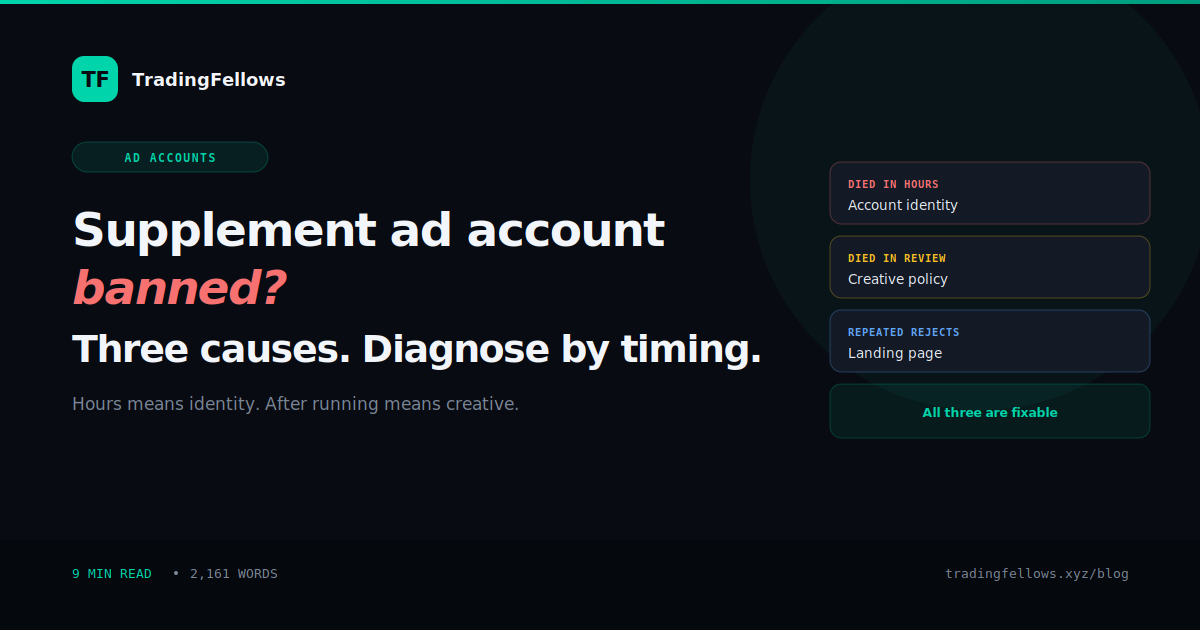
A supplement ad account gets banned for three reasons: the identity was flagged at creation, the creative broke a health or personal attributes policy, or the landing page failed review. Accounts that die within hours are an identity problem. Accounts that run then stop are a creative problem.
On this page
- Why do supplement ad accounts get banned?
- Cause one: the account was flagged before your ads ran
- Cause two: the creative broke a policy you did not know existed
- Cause three: the landing page failed review
- How do you tell which one killed your account?
- Can you get a banned supplement ad account back?
- How to rebuild so it does not happen again
- Warming a new supplement ad account
- The bottom line
- Frequently asked questions
- Why does my supplement ad account keep getting banned?
- Can you advertise supplements on Facebook at all?
- How long does a supplement ad account ban last?
- What is the most common reason supplement ads get rejected?
- Should I appeal or start a new supplement ad account?
- How many ad accounts should a supplement brand run?
Your supplement ad account is gone. Possibly before a single ad finished review.
You removed the before and after images. You stripped every number out of the copy. You added the FDA disclaimer. And the account died anyway, with a notice that named a policy but not the thing you actually did.
There are only three reasons a supplement ad account gets banned. Two of them are your fault and fixable. One of them is not, and knowing which you are dealing with decides whether you spend the next week rebuilding or appealing.
A supplement ad account gets banned for three reasons: the account identity was flagged at creation, the creative broke a health or personal attributes policy, or the landing page failed review. Accounts that die within hours, usually before ads run, are an identity problem. Accounts that run for a while then stop are a creative or landing page problem. Identify which before you rebuild, because the fixes have nothing in common.
Why do supplement ad accounts get banned?#
Supplements sit in a restricted category, which means heightened automated scrutiny from the moment the account exists. The three causes are the account identity being flagged at creation, ad creative breaking health or personal attributes rules, and the landing page failing the check that happens during ad review. Nutra advertisers face all three at higher rates than unrestricted businesses.
The reason a supplement ad account is harder to keep than a clothing store's is not that supplements are banned. They are not. It is that the category has a long history of misleading advertising, so the baseline risk score starts higher and the margin for anything sloppy is thinner.
Cause one: the account was flagged before your ads ran#
Meta scores an ad account when it is created, using signals available immediately. The IP address it was created on, the phone number used to verify it, the payment card attached and the browser fingerprint of the machine behind it. A supplement ad account created on a datacenter IP with a mismatched card is high risk before any creative is submitted.
This is the cause people misdiagnose most often, because the ban notice mentions a policy and so the advertiser goes and rewrites the creative.
The creative was never reviewed. The account was.
Four signals, and what matters is whether they agree with each other rather than whether each is individually valid:
- IP. Residential, in the country the business operates from. Datacenter and VPN addresses carry history from everyone else who used them.
- Phone. A real carrier mobile that will still answer in six weeks when re-verification asks. VOIP and disposable SMS numbers are the cheapest signal to fake and are weighted accordingly.
- Card. Name and issuing country matching the account. A card from one country on an account registered in another is a mismatch even when both are genuine.
- Browser. A clean profile. Fingerprints survive cleared cookies and incognito, so a machine that hosted a banned account taints the next one created on it.
Buying a replacement and setting it up on the same laptop, same browser and same connection as the last three reproduces the exact conditions that killed them. The supplement ad account is new. Everything Meta uses to score it is not.
Cause two: the creative broke a policy you did not know existed#
The health policies are stricter than most advertisers expect, and the one that catches nearly everyone is not about health claims at all. Meta prohibits ads that assert or imply knowledge of a person's characteristics, including their body and health. "Struggling with belly fat" violates it. "The formula our customers reorder most" does not.
That is the personal attributes rule, and it rejects more nutra creative than anything else on the list, because the rejection notice describes it in language that does not obviously map to the headline you wrote.
The rest of the list is more familiar:
- Before and after imagery in any form, including inside customer video
- Specific outcome claims, meaning any weight, size, percentage or timeframe
- Guarantee language, including "risk-free" and "results guaranteed"
- Idealised or negative body imagery
- Profit or transformation screenshots inside testimonials
There is a fuller breakdown of the copy patterns if the creative side is where your supplement ad account is failing.
Cause three: the landing page failed review#
Meta's reviewers open the destination page as part of ad review, and a page missing required elements gets the ad rejected even when the creative is compliant. Supplement landing pages need the FDA disclaimer positioned near the product claims rather than buried in a footer, a full supplement facts panel, clear company details, and unambiguous subscription terms if billing recurs.
The subscription point catches a lot of nutra advertisers. If you run a trial that converts to recurring billing and the terms are not obvious before checkout, that is a policy problem regardless of whether the disclosure technically exists somewhere on the page.
Meta publishes its health and wellness advertising standards in the Transparency Center, and the landing page requirements are worth reading directly rather than through a summary.
How do you tell which one killed your account?#
Use the timing. It is the most reliable signal available and it costs nothing to check.
| Symptom | Likely cause | Fixable |
|---|---|---|
| Died within hours, before ads ran | Account identity | Yes, permanently |
| Died during first ad review | Creative or landing page | Yes, rewrite |
| Ran for days then stopped | Creative or landing page | Yes, rewrite |
| Ran for weeks then stopped | Policy strike accumulation | Sometimes |
| Third account in a row dies fast | Shared infrastructure across all three | Yes, isolate them |
Can you get a banned supplement ad account back?#
Appeals succeed when the restriction was a false positive on an otherwise well-built account. Submit through Account Quality with business documentation and a landing page that clearly meets policy. Appeals rarely succeed where the underlying signal was real, meaning the account was created on a VPN, used a disposable number, or carried a mismatched payment method, because in those cases the flag was accurate.
Set your expectations by which cause you identified.
If it was creative, fix the creative and appeal. That is a genuine misunderstanding and reviewers can be persuaded.
If it was the identity stack, the flag was correct. Weeks spent waiting on an appeal that will not succeed are weeks not spent running a properly built replacement.
How to rebuild so it does not happen again#
The last item is the one most nutra advertisers skip and the one that decides how much a restriction actually costs. A single supplement ad account is a single point of failure. Two or three, each with its own IP, number, card and browser profile, means a ban costs you one channel rather than your entire acquisition.
They have to be genuinely separate. Accounts sharing infrastructure are linkable, and a restriction on one can reach the others.
Worth saying plainly, because a lot of sellers will not: no supplier can stop a restriction caused by your ad content or by the vertical itself. What clean infrastructure buys you is the run before it. Spend that clears, campaigns that finish, no flag on day one. It does not buy immunity, and anyone selling you immunity is selling a lifespan they do not control.
If you need to be running the same day rather than warming for three to five days, the Launch-Ready tier at $499 hands over with seven days of spend history and a $250/day limit already unlocked.
A real US phone number that survives re-verification, a clean residential IP from a home line, and a virtual card matched to the BM identity. The three signals that get scored, already agreeing. Credentials land in your dashboard in minutes. Setup faults on our end are replaced free within 24 hours.
Warming a new supplement ad account#
Restricted categories need more warm-up than general ecommerce, because the baseline scrutiny is higher and a sudden spend ramp is itself a risk signal.
Skipping this is the second most common way a supplement ad account dies, after the identity stack. The instinct to scale immediately is strong when the account cost money and the campaign is waiting. It is also the thing that gets the account flagged in week two.
The bottom line#
A supplement ad account banned in the first few hours is an identity problem. One banned after running is a creative or landing page problem. They are different failures with different fixes and treating them as the same thing is why people rebuild four times and get the same result.
Diagnose by timing. Fix the layer that actually failed. Warm the replacement instead of scaling into it. And run more than one, because in a restricted category the question is not whether a restriction arrives but how much it costs you when it does.
Frequently asked questions#
Why does my supplement ad account keep getting banned?#
Most repeat bans are caused by shared infrastructure. Creating each replacement on the same machine, browser, IP and payment method as the previous one reproduces the signals that flagged the original. Browser fingerprints survive cleared cookies and incognito mode, so a new account on an old machine inherits the association with the banned one.
Can you advertise supplements on Facebook at all?#
Yes. Supplements are restricted rather than prohibited. Meta allows supplement advertising from businesses that follow the health and wellness policies, which means no personal attributes language, no before and after imagery, no specific outcome claims, and a landing page carrying the FDA disclaimer and full ingredient information.
How long does a supplement ad account ban last?#
Some restrictions lift after review within a few days. Many are permanent, particularly where the account was flagged for identity reasons rather than a single creative breach. Appeals through Account Quality typically resolve within a few business days, but success depends on whether the original flag was accurate.
What is the most common reason supplement ads get rejected?#
The personal attributes policy, which prohibits implying knowledge of the viewer's body or health. Copy addressing the reader in second person about their weight or appearance violates it, even without any health claim. Most advertisers never identify this as the cause because the rejection notice describes the policy rather than the specific line that triggered it.
Should I appeal or start a new supplement ad account?#
Appeal if the account had a clean identity setup and the restriction followed a creative issue you can demonstrate you have fixed. Start fresh if the account was built on a VPN, a disposable phone number or a mismatched card, because in that situation the flag was accurate and the appeal is unlikely to change it.
How many ad accounts should a supplement brand run?#
At least two, ideally three if you are spending meaningfully, so a single restriction does not take your whole funnel offline. Each needs a separate IP, phone number, payment method and browser profile. Accounts sharing infrastructure can be linked together, which means a ban on one can cascade to the others and removes the benefit of running more than one.
Frequently Asked Questions
Why does my supplement ad account keep getting banned?
Can you advertise supplements on Facebook at all?
How long does a supplement ad account ban last?
What is the most common reason supplement ads get rejected?
Should I appeal or start a new supplement ad account?
How many ad accounts should a supplement brand run?
Ready to scale your ad spend?
Priced on the page, real stock counts, paid in USDT. Setup faults on our end are replaced free within 24 hours.
See ad accounts →Keep reading
Forex Content Marketing: The Complete Strategy for Brokers and Prop Firms in 2026
Your forex broker spends $15,000/month on Facebook ads. Every time an ad account gets banned, you lo
Facebook Ads for Supplements | How to Run Nutra Campaigns Without Getting Banned 2026
Your supplement ad got rejected....
How to Get a Facebook Business Manager That Actually Survives 2026
Getting a Facebook Business Manager that survives requires a clean identity stack (residential IP, r