
Prop Firm Ad Account Banned? The 3 Reasons It Keeps Happening
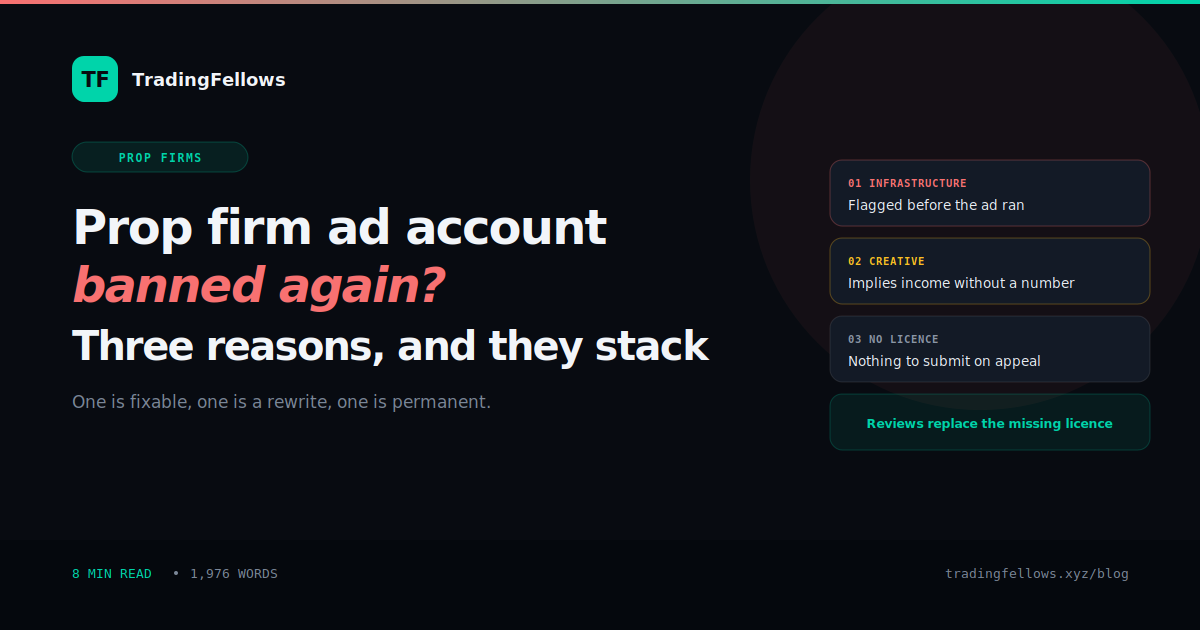
A prop firm ad account gets banned for three stacking reasons: the account infrastructure was flagged before your first ad, the creative implies income even without a figure, and unlike a licensed broker you have no regulatory licence to submit on appeal.
On this page
- Reason one: your prop firm ad account was banned before the ad ran
- Reason two: the creative implies income even when it does not claim it
- Reason three: you have no licence to submit
- Why social proof does heavier lifting for prop firms
- What to do when your prop firm ad account is banned
- The bottom line
- Frequently asked questions
- Why does my prop firm ad account keep getting banned?
- Can prop firms advertise on Facebook at all?
- What words should prop firms avoid in ads?
- Do prop firms need a licence to advertise?
- How many ad accounts should a prop firm run?
- Why do Trustpilot reviews matter more for prop firms than brokers?
Your prop firm ad account is banned again. Third one this quarter.
The creative was clean. No income claims, no payout screenshots, nothing that violates anything you can find in Meta's policy documentation. And it still died.
A prop firm ad account gets banned at a higher rate than almost any other advertiser, and the reason is structural rather than something you did wrong in the ad. You are selling a paid evaluation for access to trading capital, and every automated review system on every ad platform struggles to categorise that.
A prop firm ad account gets banned for three reasons that stack. The account infrastructure is weak, so it was flagged before your first ad. The creative implies income from trading, which triggers financial services review even without a specific figure. And unlike a licensed broker, a prop firm has no regulatory licence to submit when the platform asks for one. Fix the first, rewrite around the second, and compensate for the third with third-party trust signals.
Reason one: your prop firm ad account was banned before the ad ran#
This is the largest cause of a prop firm ad account banned notice, and the one most often misdiagnosed as a policy problem.
Meta scores an ad account when it is created, using the IP it was created on, the phone number that verified it, the payment method attached and the browser fingerprint. None of that has anything to do with prop firms. An account built on a datacenter IP with a mismatched card is high risk before anyone reads your copy.
What makes a banned prop firm ad account more likely than most is that the category already sits inside financial services, so your baseline scrutiny starts higher than a clothing brand's. The margin a weak setup gets elsewhere does not exist here. The full breakdown of what Meta checks at account creation applies to you with less tolerance than it applies to anyone else.
If you have had a prop firm ad account banned three times and each replacement was set up on the same laptop, same browser profile and same connection as the last one, you have reproduced the exact conditions each time. The account is new. Everything used to score it is not.
Reason two: the creative implies income even when it does not claim it#
Most prop firm marketing has a language problem that broker marketing does not, and it is the second reason accounts go down.
A broker sells a platform. You sell access to capital, and the entire appeal of that is what a trader might earn with it. Every natural way to describe the product edges toward an income claim, which is exactly what financial services review is built to catch.
The trap is that you can trigger it without writing a single number.
| Reads as income promise | Reads as product description |
|---|---|
| Get funded and trade our capital | Take the evaluation, prove your consistency |
| Turn your skill into a funded account | A two-phase challenge with defined rules |
| Trade $100K without risking your own money | Trading conditions, platforms and instruments we support |
| Keep 90% of what you make | Profit split terms published in full before you start |
| Join our funded traders | Join 10,000 traders who have taken the challenge |
"Funded trader" is the industry's own term, so it feels neutral. To an automated classifier it reads as a promise of capital and, by implication, income. It is not banned outright, but it raises your risk score every time it appears in copy. Leading with evaluation, challenge and skill assessment instead moves the emphasis from what the trader gets to what the product is.
Reason three: you have no licence to submit#
This is the third reason a prop firm ad account gets banned and the structural disadvantage nobody talks about, and it separates you from every regulated advertiser you compete with for impressions.
When a forex broker's account gets flagged, they submit an FCA, CySEC or ASIC licence and the platform has a recognised document to verify against. When a crypto exchange applies for permission, Meta accepts a defined list of regulatory registrations.
A prop firm generally holds none of these, because in most jurisdictions the model is not a regulated activity. You are not taking client deposits or executing trades on their behalf, so there is nothing to be licensed for.
That is legally fine and commercially awkward. It means:
- Appeals are weaker, because you cannot answer the question the appeal form is really asking
- You cannot access the certification routes open to licensed financial advertisers
- Automated systems see a financial offer with no verifiable regulatory backing, which is the exact profile of the scams they are trained on
Why social proof does heavier lifting for prop firms#
Because a prop firm has no licence to point at, third-party reviews are not a nice addition to your marketing. They are the substitute for the credibility signal you structurally cannot produce.
A trader deciding whether to pay a challenge fee has one real question: does this firm actually pay out. They will not find the answer on your website, because every prop firm site says yes. They go to Trustpilot, and what they find there decides it.
That is why an empty review profile costs a prop firm more than it costs a broker. The broker has a regulator standing behind them in the reader's mind. You have whatever your last hundred customers said in public.
The reviews that convert for prop firms are specific about the thing traders doubt: payout received and how fast, evaluation rules applied consistently, no moved goalposts after passing, support responding when it mattered. Generic praise does nothing. How to build that profile is a separate piece, but the priority order for a prop firm is Trustpilot first, everything else second.
Built on a residential IP with a real phone and a matched card, then warmed with seven days of clean spend so the $250/day limit is already unlocked. Delivered within 24 hours with a 24-hour replacement guarantee.
What to do when your prop firm ad account is banned#
Appeal through Meta Account Quality with your business documentation, published challenge terms and a landing page carrying clear risk disclosure. Appeals occasionally succeed where the flag was a false positive on a well-built account.
Set expectations honestly though. Without a regulatory licence your appeal is thinner than a broker's, and if the underlying account was weak, the flag was correct and reviewing it will confirm that. In most cases the faster route is a properly built replacement.
Do not build that replacement on the machine the last one died on.
And run more than one account from the start. Not to evade anything, but because a single restriction should never take your entire funnel offline mid-campaign. Each account needs its own IP, number, card and browser profile, because accounts sharing infrastructure are linkable and a ban on one can reach the others.
The bottom line#
A prop firm ad account banned once is bad luck. Banned three times is a stack of three reasons, and fixing one while ignoring the others just changes which one kills you.
The infrastructure is the part fully within your control, so start there. The creative is a rewrite away, and the rewrite costs you some punch in exchange for ads that actually run. The missing licence is permanent, so the answer is not to fix it but to make it matter less by building the trust signals you can control.
None of this makes a prop firm ad account as easy to run as a shoe brand's. It makes the difference between accounts measured in months and accounts measured in days.
Frequently asked questions#
Why does my prop firm ad account keep getting banned?#
Three causes stack. The account was likely flagged at creation because of a weak identity setup, meaning a datacenter or VPN IP, a recycled phone number or a mismatched payment card. The creative implies income from trading, which triggers financial services review even without specific figures. And prop firms hold no regulatory licence to submit, so automated systems see a financial offer without verifiable backing.
Can prop firms advertise on Facebook at all?#
Yes. Prop firms are not prohibited. They face heightened review because the model sits inside financial services and the offer is difficult for automated systems to categorise. Ads that frame the product as a skill evaluation with published rules, rather than as access to capital and earnings, pass review at a much higher rate.
What words should prop firms avoid in ads?#
Any figure attached to earnings, profit splits stated as a benefit, payout amounts, and guarantee language. "Funded trader" is not banned but raises risk because it implies capital and income. Safer framing uses evaluation, challenge, assessment, trading conditions and published rules, which describe the product rather than what the trader might get from it.
Do prop firms need a licence to advertise?#
In most jurisdictions prop firms are not carrying out a regulated activity, since they do not take client deposits or execute trades for clients, so no licence is typically required to operate. The commercial problem is that ad platforms increasingly ask financial advertisers to verify regulatory status, and a prop firm has nothing to submit. That weakens appeals and removes access to certification routes open to brokers.
How many ad accounts should a prop firm run?#
At least two, ideally three if you are spending meaningfully, so a single restriction never takes your whole funnel offline. Each needs a separate IP, phone number, payment method and browser profile. Accounts sharing infrastructure can be linked together, and a ban on one can cascade, which removes the benefit of running more than one.
Why do Trustpilot reviews matter more for prop firms than brokers?#
A regulated broker has a licence acting as an external credibility signal. A prop firm has none, so third-party reviews carry the weight instead. Traders deciding whether to pay a challenge fee want to know whether the firm pays out, and they look for that answer on review platforms rather than on your website. An empty profile therefore costs a prop firm more than it costs a licensed broker.
Frequently Asked Questions
Why does my prop firm ad account keep getting banned?
Can prop firms advertise on Facebook at all?
What words should prop firms avoid in ads?
Do prop firms need a licence to advertise?
How many ad accounts should a prop firm run?
Why do Trustpilot reviews matter more for prop firms than brokers?
Ready to scale your ad spend?
Verified ad accounts, real reviews, and growth tools. 24-hour delivery. Money-back guarantee.
See Products & Pricing →Keep reading
Forex Content Marketing: The Complete Strategy for Brokers and Prop Firms in 2026
Your forex broker spends $15,000/month on Facebook ads. Every time an ad account gets banned, you lo
Facebook Ads for Supplements | How to Run Nutra Campaigns Without Getting Banned 2026
Your supplement ad got rejected....
How to Get a Facebook Business Manager That Actually Survives 2026
Getting a Facebook Business Manager that survives requires a clean identity stack (residential IP, r