
How to Market a Prop Firm Online in 2026 | The Complete Advertising and Social Proof Guide

To market a prop firm online, you need three layers working simultaneously: clean ad accounts on Meta and TikTok, 50+ Trustpilot reviews that convert the 87% of traders who Google your brand, and SEO content that builds organic traffic independent of ad platforms.
On this page
- What prop firm marketing is actually selling
- The second tab, in order
- Where the leak actually is
- Which layer to build first
- Layer one: proof that survives being checked
- Layer two: ads, and why prop firm accounts die
- Layer three: content you own
- How to market a prop firm on a real budget
- The timeline
- Who should not run this playbook
- What prop firm marketing will not fix
- The bottom line
- Frequently Asked Questions
Two prop firms. Same evaluation structure, same profit split, same platform, same fee.
One takes twenty signups a month. The other takes four hundred.
The obvious explanation is budget, and it is usually wrong. I have watched firms triple their spend into that gap and close it by nothing, because the thing standing between a trader and your checkout page is not reach.
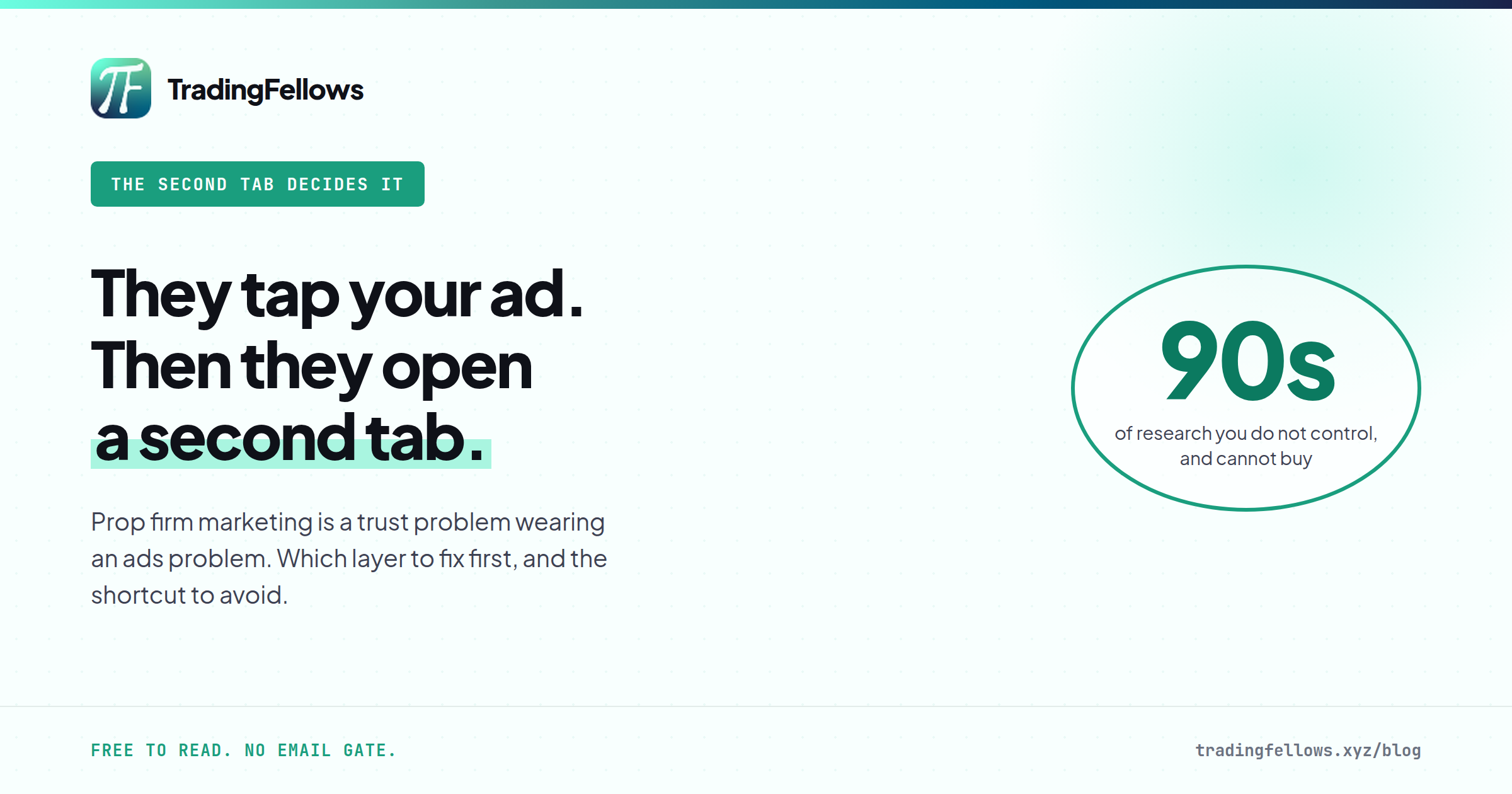
It is ninety seconds of research that happens after they click your ad and before they pay you, and no amount of prop firm marketing spend reaches into it.
They open a second tab. They search your brand name. They look at your reviews, they look at what comes up on Reddit, they look for whether anyone has posted a payout from you this month. And in a market where firms have collected challenge fees and then disappeared, that research is not paranoia. It is the correct behavior, and your prospect is doing it right now.
Prop firm marketing is the job of surviving that second tab. Everything else is traffic.
I want to walk you through what the trader actually checks, which of the three layers to build first depending on what a stranger finds today, why prop firm ad accounts die more often than anyone else's, and the one shortcut in this industry that looks like a growth hack and is actually a liability you cannot unwind.
The short answer: Prop firm marketing has three layers and they are not equal.
Proof comes first, because a trader researches your brand before paying a few hundred dollars for an evaluation, and a thin profile converts paid traffic into bounces.
Ads come second, and prop firms sit in a restricted financial services category on every major platform, so accounts need redundancy rather than cleverness.
Content comes third and slowest.
The order matters more than the budget: ads pointed at an unverifiable brand are the most expensive mistake in this vertical, and the fastest way to fix it is also the only legitimate one.
What prop firm marketing is actually selling#
Prop firm marketing is not selling an evaluation. The evaluation is a commodity and your prospect knows it: the rules, the split, the drawdown calculation and the platform are close enough across a crowded field that a trader can compare five firms in an afternoon and find no real difference.
What they are actually buying is a prediction. Will this company still exist in three months, and will it pay me when I win? Every prop firm marketing decision either supports that prediction or undermines it.
That is an unusual thing to sell, and it explains the behavior that confuses most prop firm owners. It explains why a trader will pay more to a firm with a long review history than to an identical firm with a better split. It explains why one unanswered complaint about a moved goalpost costs more than ten positive reviews recover. And it explains why spend alone does not move the number.
The second tab, in order#
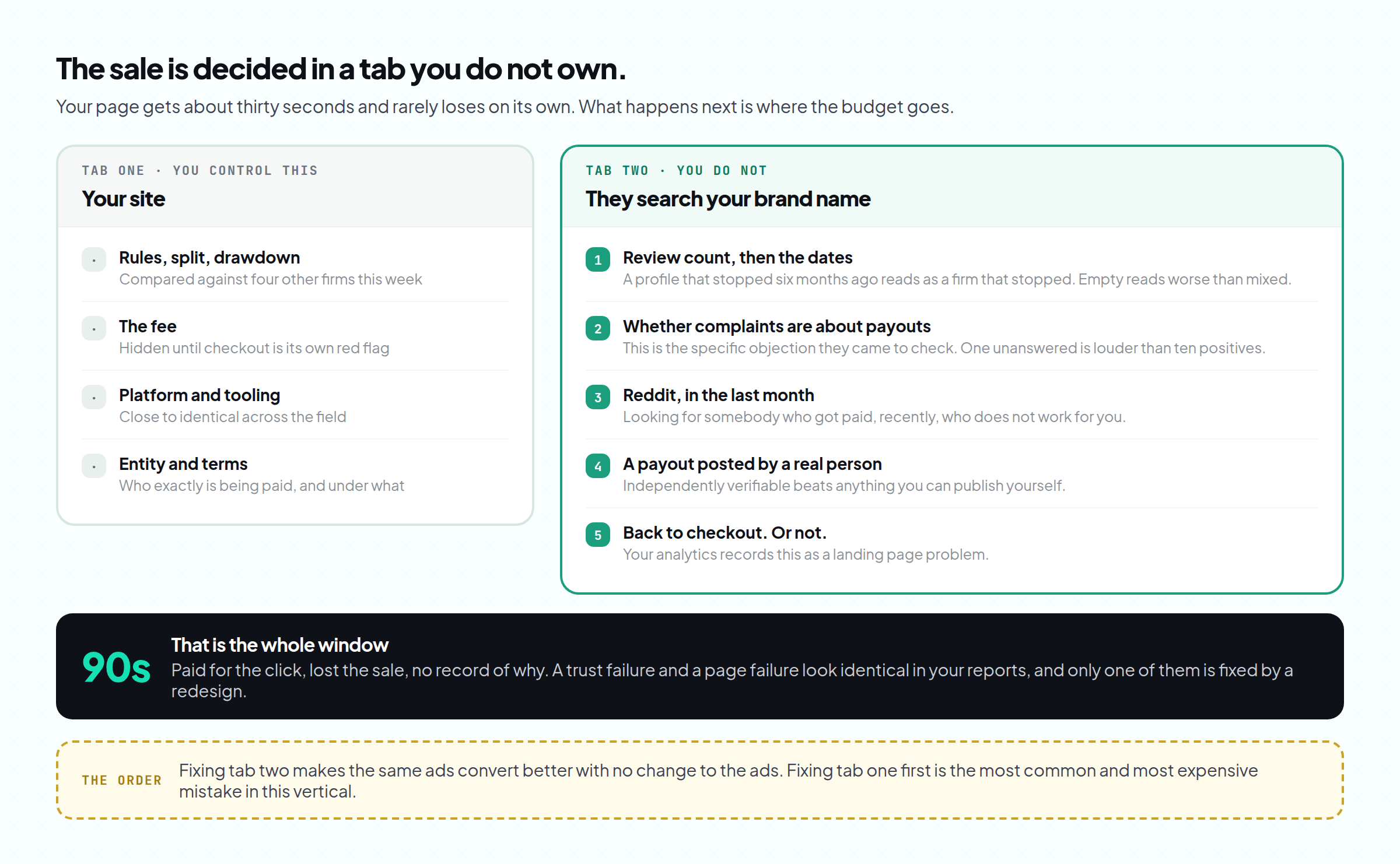
Here is the path your paid click actually takes, and the part of prop firm marketing nobody maps. Every prop firm marketing decision you make is either helping or hurting somewhere on it.
- The adThey tap. You have been charged. Nothing has been decided.
- Your siteRules, split, platform, fee. This takes about thirty seconds and almost never loses the sale on its own.
- A new tabThey search your brand name. This is the moment the sale is won or lost, and it happens somewhere you do not control.
- The review profileCount first, then recency, then whether the complaints are about payouts. An empty profile reads worse than a mixed one.
- Reddit and YouTubeThey are looking for one specific thing: somebody who got paid, recently, who is not you.
- Back to checkoutOr not. And your analytics will record this as a landing page problem.
The last line is why so many prop firms rewrite their checkout page for a month and move nothing.
That last point deserves saying twice, because it costs real money. A trust failure and a landing page failure look identical in your reports. Both show traffic arriving and not converting. One is fixed by a page redesign and the other is not, and in this vertical it is usually not. The general version of that diagnosis is in high CTR, no conversions.
Where the leak actually is#
Prop firm marketing reports almost never show this, so run it on your own numbers rather than taking anybody's benchmark, including mine.
- Clicks you paid for2,000
- Reached the site1,70085% of the step before · healthy: 85%+
- Searched your brand name90053% of the step before
- Came back and signed up809% of the step before
Example numbers for one month, to show the shape rather than a benchmark. The third number on the first line is a reasonable minimum for clicks that become visits. Tap "Use my numbers" to put your own month in.
Read it left to right and stop at the first step that breaks. If clicks are not becoming visits, your problem is upstream of everything in this guide and it is usually page speed on a phone. If visits are becoming brand searches and not coming back, the second tab is where your budget is dying, and no amount of additional traffic fixes it. You would just be buying more people to go and not find you.
Which layer to build first#
Prop firm marketing advice almost always starts with ads, because ads are the part that feels like marketing. For most firms reading this, ads are the wrong first move.
Search your own brand name in an incognito window right now. What does a stranger find?
How long have you been publishing anything searchable?
Every dollar of ad spend is currently buying people who will go and find nothing. Fix the profile first and the same ads convert better.
Go to the fixA profile that stopped is a worse signal than a small one. Traders read the dates. Restart the invitation flow this week.
Go to the fixThis is the single highest-value hour available to you. An unanswered payout complaint is the one objection your prospect is specifically looking for.
Go to the fixYour conversion layer is fine. You have an uptime problem, and it has a different fix.
Read that guideContent is the slowest layer and the only one that keeps working when an account dies. Starting it late is the most common regret in this vertical.
Read that guideThe step change comes from internal linking far more than from publishing more.
Read that guideThe first question is free and takes a minute. Most firms have never done it from a clean browser.
Layer one: proof that survives being checked#
Your review profile is the part of your prop firm marketing that does the selling in the moment that decides the sale, which makes it the highest-leverage thing in prop firm marketing and the one most firms treat as an afterthought.
What a trader is scanning for, roughly in this order:
- Payout confirmations with dates. Not "great platform". Somebody saying they were paid, and when.
- Recency. A profile that stopped six months ago reads as a firm that stopped.
- How you handled the bad ones. A reasonable reply to an angry review converts better than the angry review costs.
- Specificity. Reviews that name the rule they passed under or the withdrawal time they got are believed. Generic praise is discounted by everyone, including the platforms.
Buying reviews is the standard prop firm marketing advice in this industry and you should not take it.
It is against the rules of the platform you would be buying them on.
com/end-user-terms-and-conditions/guidelines-for-reviewers) require a review to be based on genuine personal experience, state that incentivized reviews are not allowed, and say the company may be asked to validate that an experience happened.
Reviews that fail that are removed.
And removal is the small problem.
They come off in retrospective batches, because detection runs on patterns across a group rather than the wording of any single review: how fast they arrived, how similar the accounts are, what networks they came from.
So the rating does not drift back down gradually.
It drops in one visible step, at a random future date, and the profile is scrutinized harder afterwards, which makes the legitimate reviews you collect later slower to stick.
Now apply that to this specific business.
You are asking people to pay a few hundred dollars up front on the strength of a trust signal.
If the signal was manufactured and later deleted, you have not just lost a rating.
You have handed every disgruntled trader a provable story, in a vertical where that story spreads on Reddit in an afternoon.
There is no version of this that is worth it, and the honest route is faster than it looks: a firm paying out regularly can build a real profile in weeks, because you have a natural trigger that most businesses do not.
Layer two: ads, and why prop firm accounts die#
Prop firm marketing runs inside the restricted financial services category on every major platform. Google requires verification for financial products and services advertising. Meta applies extra review to the same category. That is the baseline, and it means your account is read more harshly than an e-commerce account from the first impression.
The creative line is narrower than most firms realize, and it is where recoverable mistakes happen:
| Works | Gets actioned |
|---|---|
| Framing the product as a skill evaluation | Any income figure, in text or on a screenshot |
| What the platform and the rules are | "Guaranteed funding", "guaranteed payout" |
| Who it is for, and who it is not for | "Risk-free", when there is a fee |
| Community, support, tooling | Payout screenshots as the hook |
| Clear fees and terms on the landing page | A landing page that hides the fee until checkout |
On infrastructure, be careful what advice you take. A legitimate prop firm with a real entity should be advertising from its own verified portfolio, not hiding behind someone else's. What you actually need is redundancy, which is a different thing: more than one account so that an action against one does not stop all delivery, with the spares held separately. That is covered properly in backup ad accounts, and the ownership question underneath it is in the agency ad account guide.
Platform by platform, briefly. Meta carries the strongest audience modeling, built from traders who actually passed and got paid, and the highest enforcement risk. TikTok reaches a younger audience and rewards creator-style footage over polished brand work, with its own account setup and approval path. Google search captures someone who has already decided to buy a challenge and is only choosing the firm, which makes it the smallest and most valuable traffic in prop firm marketing. Run more than one. A firm on a single platform is one enforcement action away from zero.
Layer three: content you own#
Everything above is rented prop firm marketing. The accounts can be disabled and the review platform can change its policy, and neither of those is under your control.
Content is the layer that keeps working on the morning an account dies, and it is slow enough that the right time to start it is while the other two are still paying. The terms worth writing for are narrow and have money behind them: your firm against each competitor by name, the specific rule questions traders search before paying, payout and withdrawal questions, and strategy-qualified comparisons. The full version of this argument, including an honest timeline, is in forex content marketing.
How to market a prop firm on a real budget#
A starting split for a prop firm marketing budget, offered as a starting point rather than a formula. Move it as soon as your own numbers say something different.
| Monthly budget | Ads | Proof | Content |
|---|---|---|---|
| Getting started | 60% | 30% | 10% |
| Growing | 65% | 15% | 20% |
| Scaling | 70% | 10% | 20% |
One correction to the standard advice here. Social proof is often sold as a one-time purchase that works forever. It is not a purchase at all, and it is not one-time: a profile that stops being fed reads as dead within a few months, which is exactly the signal you were trying to avoid.
The timeline#
A model, not a forecast. Your geo, your competition and how often you actually pay out will move every row.
The first row is where the money is made or lost. Two accounts rather than one costs very little in month one and is the difference between a bad Tuesday and a dead quarter.
Who should not run this playbook#
- A firm that is not paying out reliably. Prop firm marketing amplifies what you are. If payouts are slow or contested, more traffic produces more complaints, faster, in public, and you will spend the budget making the problem bigger.
- A firm with no entity and no terms. You are asking for a few hundred dollars up front from strangers. If a prospect cannot work out who they are paying, nothing in this guide helps.
- Anyone planning to buy the trust signal. Covered above. The route exists, people take it, and it ends badly in a way that is specific to this industry.
- Anyone who needs this to work in three weeks. The fast layer here is proof, and even that is weeks. There is no layer that works in days.
What prop firm marketing will not fix#
- A product traders talk about badly. Prop firm marketing is a mirror, and reviews are the glass. A firm with a reputation for moving goalposts gets a profile that says so.
- An enforcement action. Marketing does not protect the account it runs through, which is a separate problem.
- Attribution. A trader who sees your ad on Monday, researches on Wednesday and buys on Saturday from a brand search will be credited to organic. Your paid report will understate itself permanently.
- A crowded field. Being findable and verifiable is table stakes in prop firm marketing now, not an advantage. It stops you losing; it does not win on its own.
The bottom line#
Prop firm marketing looks like an advertising problem and behaves like a trust problem. Your prospect is deciding whether you will still be here and whether you will pay, and they are deciding it in a tab you do not own, using evidence you did not write.
Which reorders prop firm marketing entirely. Ads pointed at a brand that cannot be verified are the most expensive thing in this vertical, because you pay full price for the click and lose the sale somewhere you cannot see. Proof fixed first makes the same ads work better with no change to the ads at all.
And it rules one thing out completely. The shortcut that gets recommended in every prop firm marketing thread, buying the reviews, is a liability you cannot unwind in a business whose entire product is the belief that you are good for the money.
So do this today, before you touch a campaign. Open an incognito window and search your own firm's name. Read the first page the way a trader with a few hundred dollars would read it. Then look at the dates on your reviews, and find the most recent unanswered complaint about a payout. Whatever you find there is your actual marketing priority this month, and it will not be the thing you were planning to work on.
PS. The firms that grow fastest in this industry are usually not the ones with the best split. They are the ones where a stranger can confirm, in under a minute and without taking the firm's word for it, that real people got paid last week. That is a marketing asset, and the only way to own it is to have actually paid people last week.
Frequently Asked Questions
How do I advertise a prop firm on Facebook?
How many Trustpilot reviews does a prop firm need?
How much does prop firm marketing cost?
What is the best ad platform for prop firms?
Why do prop firm ad accounts keep getting banned?
Do prop firms need a blog for marketing?
Keep reading
High CTR No Conversions on Facebook Ads? The Complete 2026 Diagnosis
Your best-CTR ad set produced nothing, so you rewrote the page. If most billed clicks never became visits, non
Virtual Phone Number for Facebook: The Complete 2026 Business Manager Guide
The number that verified your Business Manager belongs to a stranger by spring. What Meta actually checks, why
Facebook Ads Payment Failed? The Complete 2026 Guide to Fixing It Fast
Either your bank refused the charge or Meta did, and the two need opposite responses. How to tell which in thr